


In a descending line clichéC♯ major
The descending line cliché: the fifth of the tonic rises a semitone, then falls into the third of the vi.
The C♯ Augmented chord is built on the root note C♯. Its notes are C♯, E♯ and G𝄪. It's enharmonically the same chord as D♭ Augmented.
Augmented chords feel floaty and uncertain. Raising the fifth of a major triad creates a symmetrical chord with no clear home, which suits transitions and dreamy film score moments.
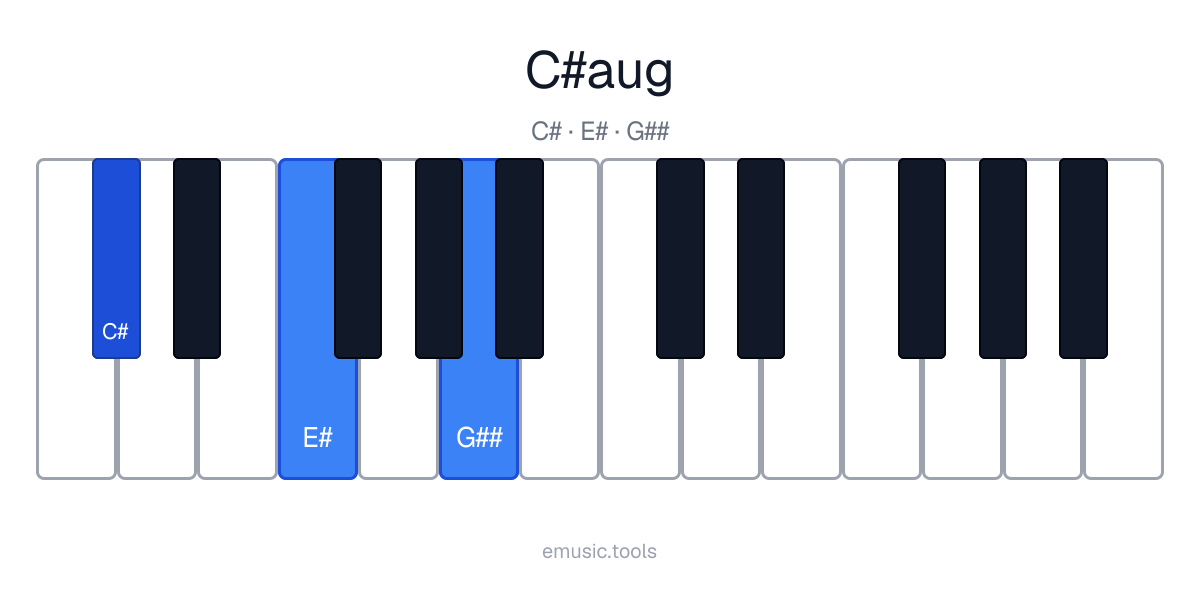
Switch to the interactive diagram to hear the chord, change voicing and swap finger numbers for note names.
To play C♯ Augmented on piano, place your right hand with your thumb on C♯, middle finger on E♯ and little finger on G𝄪. Press the keys together and listen for an even sound. On the keyboard C♯ is a black key and E♯ and G𝄪 are white, the keys you'd normally call F and A. The thumb starts on a black key, so slide the whole hand a little further in, towards the fallboard. Practice moving in and out of the chord slowly, then bring in a metronome.
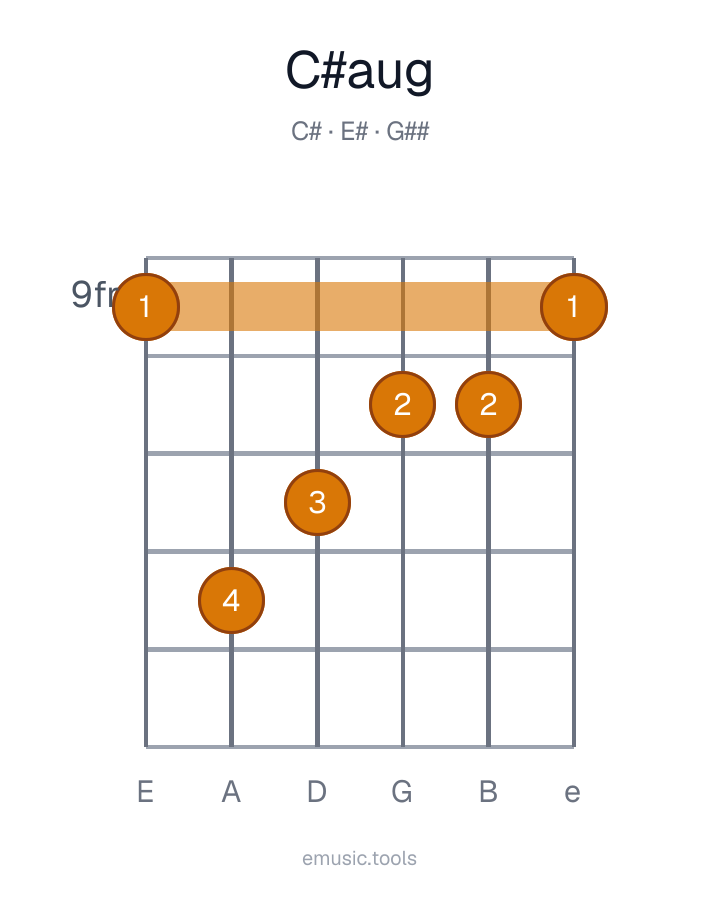
Switch to the interactive diagram to hear the chord, change voicing and swap finger numbers for note names.
On guitar, C♯ Augmented is commonly played with the voicing shown above. This one is a barre at fret 9: keep the index finger flat across the strings and curve the others so they don't mute the strings next to them.
C♯ · E♯ · G𝄪
Play C♯ Augmented on the online piano
Free, in your browser: play with the mouse, your computer keyboard or a USB MIDI keyboard. No sign-up.
Also known as D♭ Augmented
| Degree | Interval | Semitones | Note | Hear |
|---|---|---|---|---|
| 1 | Root | 0 | C♯(C#) | |
| 3 | Major third | 4 | E♯(E#) | |
| ♯5 | Augmented fifth | 8 | G𝄪(G##) |
The C♯ Augmented chord is built from a root, a major third and an augmented fifth. Start at the root C♯ and stack the intervals to get the whole chord: C♯, E♯ and G𝄪. The same formula gives you the chord in any other key.
Augmented chords show up in jazz, bossa nova, film scores and psychedelic rock. They're often used as a brief transition chord, for example between I and vi in a major key.
C♯+ raises the fifth of C♯ by a half step, so it stacks two major thirds and has no perfect fifth at all. That makes it the mirror image of C♯°, which stacks two minor thirds. Because three major thirds split the octave evenly, the same three notes form an augmented chord on each of them.
An augmented chord is unstable by construction: it turns up as a passing tonic inside a descending line, and as a dominant sharpened to pull harder.
These scales include C♯+ as one of their diatonic chords. Use them to find melodies and improvisation ideas that fit perfectly.
We use cookies to measure how the site is used and remember your settings. Details in our Privacy Policy.