


As the VG♭ major
- ii7A♭m7
- V13D♭13
- Imaj7G♭maj7
D♭13 is the chord that wants to resolve, so ending the loop on it hands straight back to the top.
The D♭13 chord is a dominant thirteenth chord built on the root note D♭. Its notes are D♭, F, C♭, E♭ and B♭. It's enharmonically the same chord as C♯13.
Dominant thirteenth chords are the fullest dominant sound in common use, a dominant seventh with a ninth and a thirteenth piled on top. The major sixth on top, sounding an octave up as the thirteenth, gives the chord a bright, open lid.
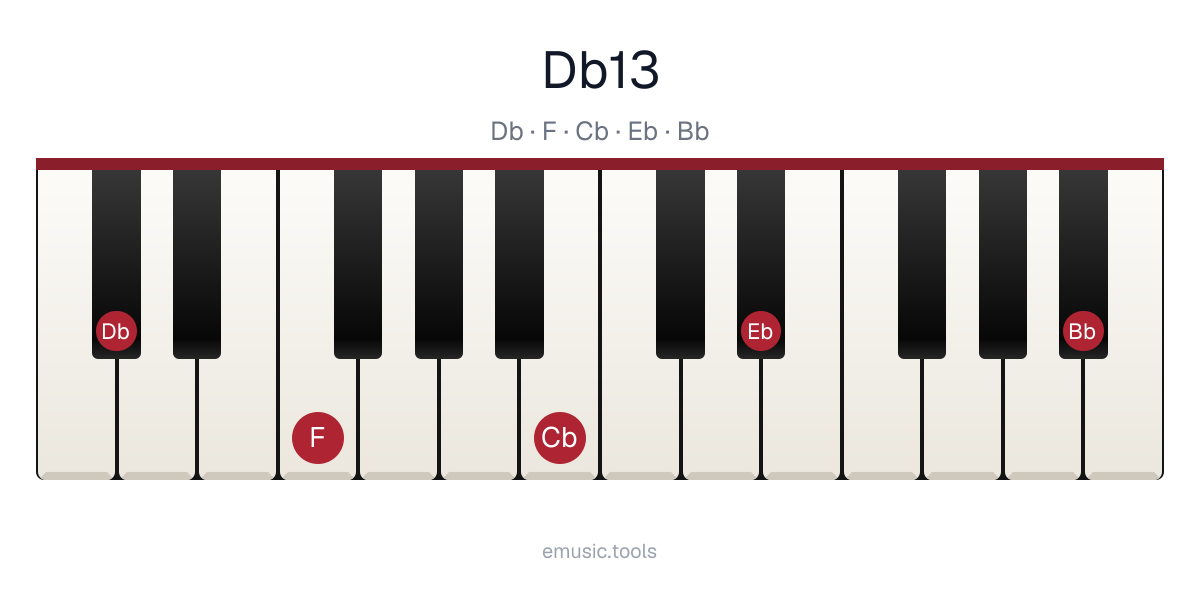
Switch to the interactive diagram to hear the chord, change voicing and swap finger numbers for note names.
To play D♭13 on piano, place your right hand with your thumb on D♭, index finger on F, middle finger on C♭, ring finger on E♭ and little finger on B♭. Press the keys together and listen for an even sound. On the keyboard D♭, E♭ and B♭ are black keys and F and C♭ are white. C♭ is the key you'd normally call B. The thumb starts on a black key, so slide the whole hand a little further in, towards the fallboard. Practice moving in and out of the chord slowly, then bring in a metronome.
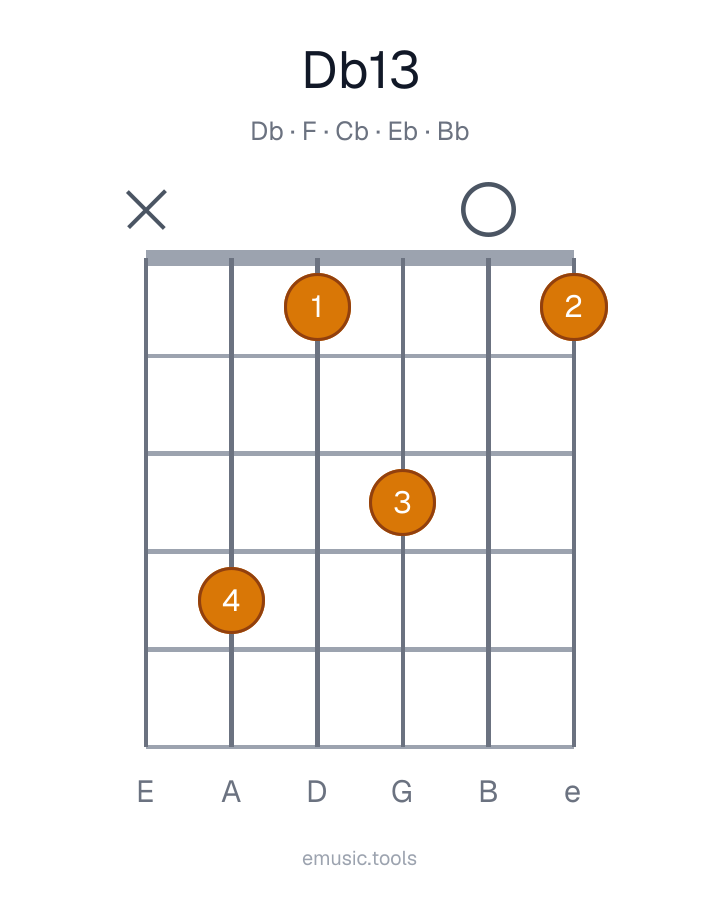
Switch to the interactive diagram to hear the chord, change voicing and swap finger numbers for note names.
On guitar, D♭13 is commonly played with the voicing shown above. The fretted notes sit between frets 1 and 4. String 2 rings open. Don't play string 6.
D♭ · F · C♭ · E♭ · B♭
Try D♭13 on the virtual piano
Free, in your browser: play with the mouse, your computer keyboard or a USB MIDI keyboard. No sign-up.
Also known as C♯13
| Degree | Interval | Semitones | Note | Hear |
|---|---|---|---|---|
| 1 | Root | 0 | D♭(Db) | |
| 3 | Major third | 4 | F | |
| ♭7 | Minor seventh | 10 | C♭(Cb) | |
| 9 | Major ninth | 14 | E♭(Eb) | |
| 13 | Major thirteenth | 21 | B♭(Bb) |
The D♭13 chord is built from a root, a major third, a minor seventh, a major ninth and a major thirteenth. Start at the root D♭ and stack the intervals to get the whole chord: D♭, F, C♭, E♭ and B♭. The same formula gives you the chord in any other key.
Dominant thirteenth chords are the default rich dominant in jazz, gospel and R&B horn and keyboard voicings, usually the V7 resolving to a major or minor tonic. Big band charts lean on them wherever a plain dominant seventh would sound thin.
D♭13 tops the dominant family, with a thirteenth over D♭7 and D♭9. The thirteenth is the sixth an octave higher, and that is the line between it and D♭6: D♭13 also has the minor seventh, so it keeps the dominant pull. The fifth and the eleventh are left out so the voicing doesn't get muddy.
A dominant chord wants to resolve. Its home is the V of a major key - and the I of a blues, where the pull never lets up.
D♭13 is the chord that wants to resolve, so ending the loop on it hands straight back to the top.
The twelve-bar shape boiled down. The tonic is itself a dominant seventh, which is what makes it a blues.
We use cookies to measure how the site is used and remember your settings. Details in our Privacy Policy.