


As the ii in a ii-V-IA major
- ii7Bm7
- V7E7
- Imaj7Amaj7
The standard cadence: Bm7 carries the subdominant function before the dominant arrives.
The Bm7 chord is a minor seventh chord built on the root note B. Its notes are B, D, F♯ and A.
Minor seventh chords are smooth and neutral, softer than a plain minor triad. They're a staple of jazz, funk and neo-soul, where they add motion without heavy tension.
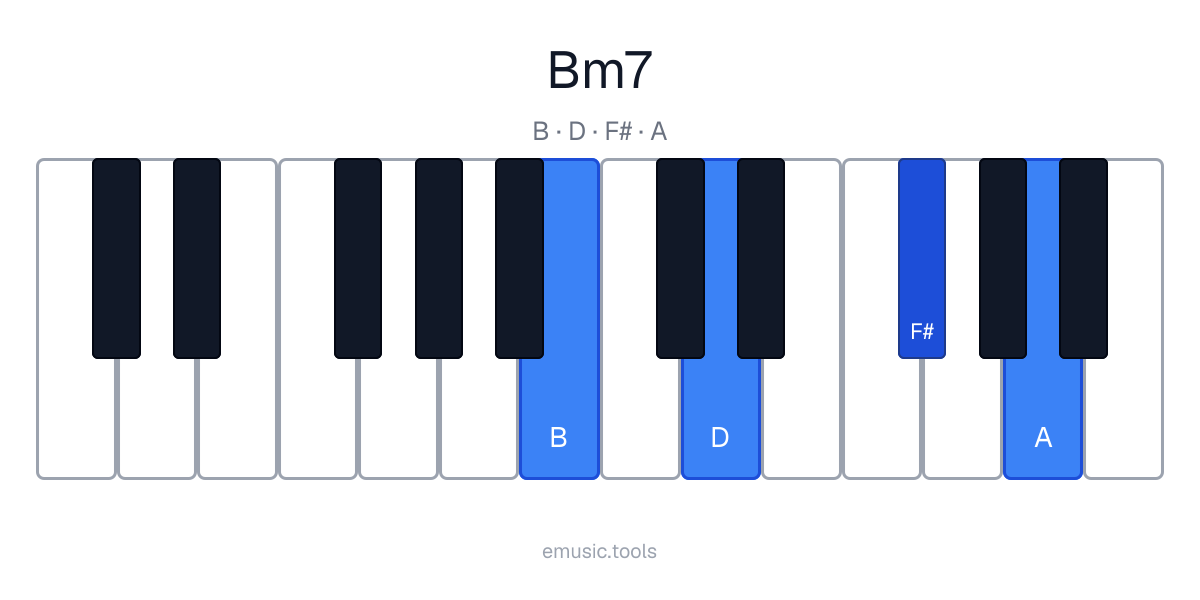
Switch to the interactive diagram to hear the chord, change voicing and swap finger numbers for note names.
To play Bm7 on piano, place your right hand with your thumb on B, index finger on D, middle finger on F♯ and little finger on A. Press the keys together and listen for an even sound. On the keyboard F♯ is a black key and B, D and A are white. Practice moving in and out of the chord slowly, then bring in a metronome.
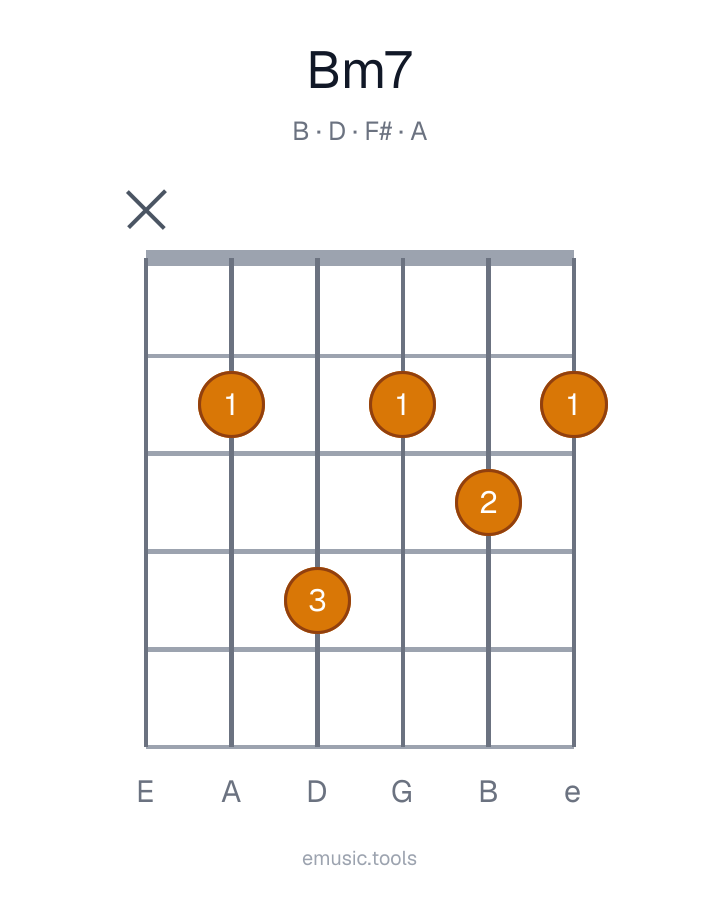
Switch to the interactive diagram to hear the chord, change voicing and swap finger numbers for note names.
On guitar, Bm7 is commonly played with the voicing shown above. The fretted notes sit between frets 2 and 4. Don't play string 6.
B · D · F♯ · A
Try Bm7 on the virtual piano
Free, in your browser: play with the mouse, your computer keyboard or a USB MIDI keyboard. No sign-up.
| Degree | Interval | Semitones | Note | Hear |
|---|---|---|---|---|
| 1 | Root | 0 | B | |
| ♭3 | Minor third | 3 | D | |
| 5 | Perfect fifth | 7 | F♯(F#) | |
| ♭7 | Minor seventh | 10 | A |
The Bm7 chord is built from a root, a minor third, a perfect fifth and a minor seventh. Start at the root B and stack the intervals to get the whole chord: B, D, F♯ and A. The same formula gives you the chord in any other key.
Minor seventh chords are foundational in jazz, funk, neo-soul and R&B. They're typically the iim7, iiim7 or vim7 chord of a major key and the i7 of a minor key.
In major keys Bm7 is the iii7 in G major, the vi7 in D major and the ii7 in A major; in minor keys it's the v7 in E minor, the i7 in B minor and the iv7 in F♯ minor.
Bm7 puts a minor seventh on a minor triad, which separates it from Bm(maj7), whose seventh is a half step higher and much sharper. Compared with Bm7♭5, it keeps a perfect fifth, so it sounds relaxed rather than tense. Its upper three notes form the major triad a minor third above the root, which is why it blends so easily with major chords.
A minor chord works as the tonic of its own key, and as the vi or the ii of a major one. Each progression below is written in the key its numerals name.
The standard cadence: Bm7 carries the subdominant function before the dominant arrives.
A turnaround. Bm7 is the relative minor of D, which softens the way back to the tonic.
A modal vamp - Bm7 is home, and the loop never resolves away from it.
We use cookies to measure how the site is used and remember your settings. Details in our Privacy Policy.