


As the VD major
- ii7Em7
- V7A7
- Imaj7Dmaj7
A7 is the chord that wants to resolve, so ending the loop on it hands straight back to the top.
The A7 chord is a dominant seventh chord built on the root note A. Its notes are A, C♯, E and G.
Dominant seventh chords sound tense and bluesy. The minor seventh on top of a major triad creates a pull toward a resolution, which is why this chord powers the blues and drives cadences in jazz and pop.
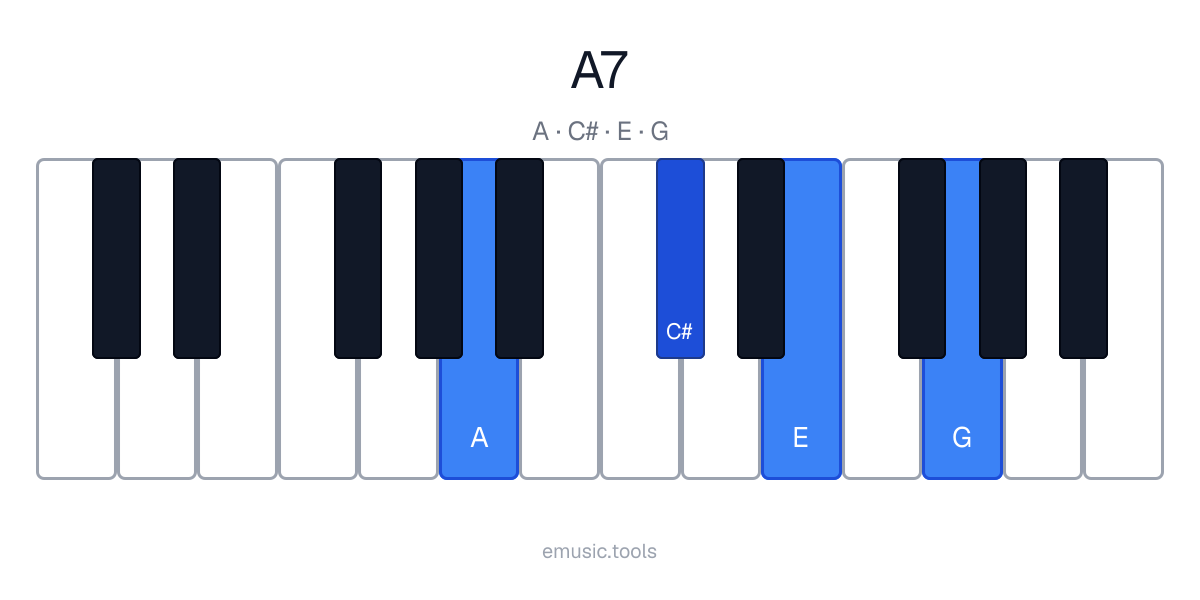
Switch to the interactive diagram to hear the chord, change voicing and swap finger numbers for note names.
To play A7 on piano, place your right hand with your thumb on A, index finger on C♯, middle finger on E and little finger on G. Press the keys together and listen for an even sound. On the keyboard C♯ is a black key and A, E and G are white. Practice moving in and out of the chord slowly, then bring in a metronome.
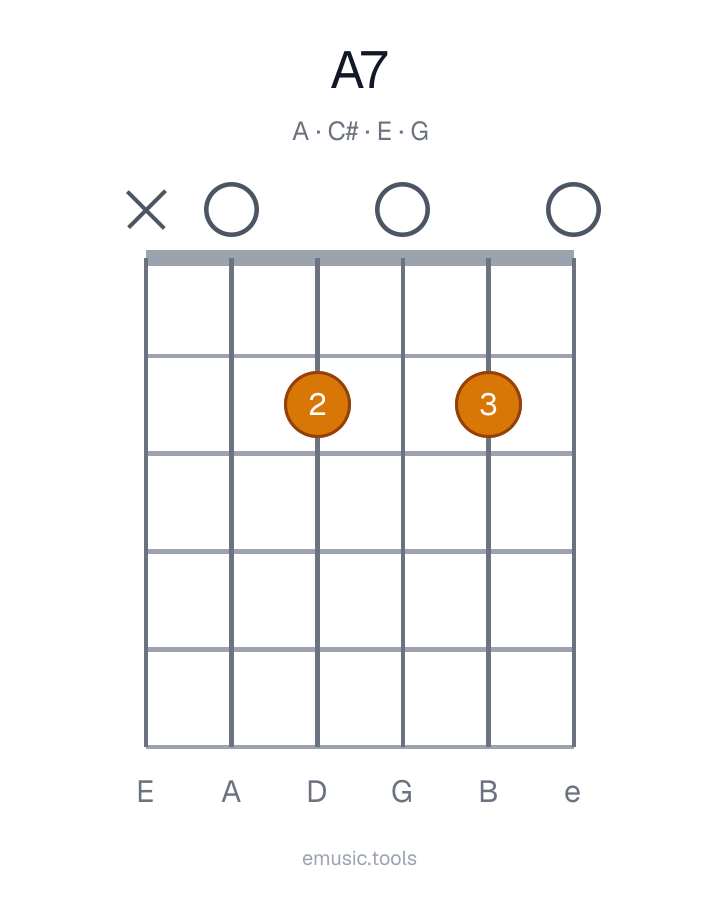
Switch to the interactive diagram to hear the chord, change voicing and swap finger numbers for note names.
On guitar, A7 is commonly played with the voicing shown above. Strings 5, 3 and 1 ring open. Don't play string 6.
A · C♯ · E · G
Try A7 on the virtual piano
Free, in your browser: play with the mouse, your computer keyboard or a USB MIDI keyboard. No sign-up.
| Degree | Interval | Semitones | Note | Hear |
|---|---|---|---|---|
| 1 | Root | 0 | A | |
| 3 | Major third | 4 | C♯(C#) | |
| 5 | Perfect fifth | 7 | E | |
| ♭7 | Minor seventh | 10 | G |
The A7 chord is built from a root, a major third, a perfect fifth and a minor seventh. Start at the root A and stack the intervals to get the whole chord: A, C♯, E and G. The same formula gives you the chord in any other key.
Blues, jazz, funk and rock'n'roll all run on dominant seventh chords. They typically act as the V7 resolving back to the tonic, or carry a twelve-bar blues from end to end.
In major keys A7 is the V7 in D major; in minor keys it's the V7 in D minor and the VII7 in B minor. As the V7 of D minor it takes its third, C♯, from the harmonic minor scale: the key's seventh degree, raised a half step.
A7 and Amaj7 look alike on paper and sound opposite: the seventh of A7 is a whole step below the octave, the seventh of Amaj7 only a half step. That minor seventh forms a tritone with the major third, the interval that makes A7 want to move on. Amaj7 has no tritone, so it can rest.
These well-known tracks all play the A7 chord somewhere - they are not necessarily in that key.
A dominant chord wants to resolve. Its home is the V of a major key - and the I of a blues, where the pull never lets up.
A7 is the chord that wants to resolve, so ending the loop on it hands straight back to the top.
The twelve-bar shape boiled down. The tonic is itself a dominant seventh, which is what makes it a blues.
The turnaround at the end of a chorus: A7 is the chord that sends it round again.
We use cookies to measure how the site is used and remember your settings. Details in our Privacy Policy.