


As the ii in a minor ii-V-iD minor
The minor cadence. Em7♭5 leads into the dominant, and the seventh is what makes it a ii rather than a diminished triad.
The Em7♭5 chord is a half-diminished chord built on the root note E. Its notes are E, G, B♭ and D.
Half-diminished chords (m7♭5) sit between a diminished triad and a minor seventh. They're the signature ii chord in minor keys and show up constantly in jazz standards and moody ballads.
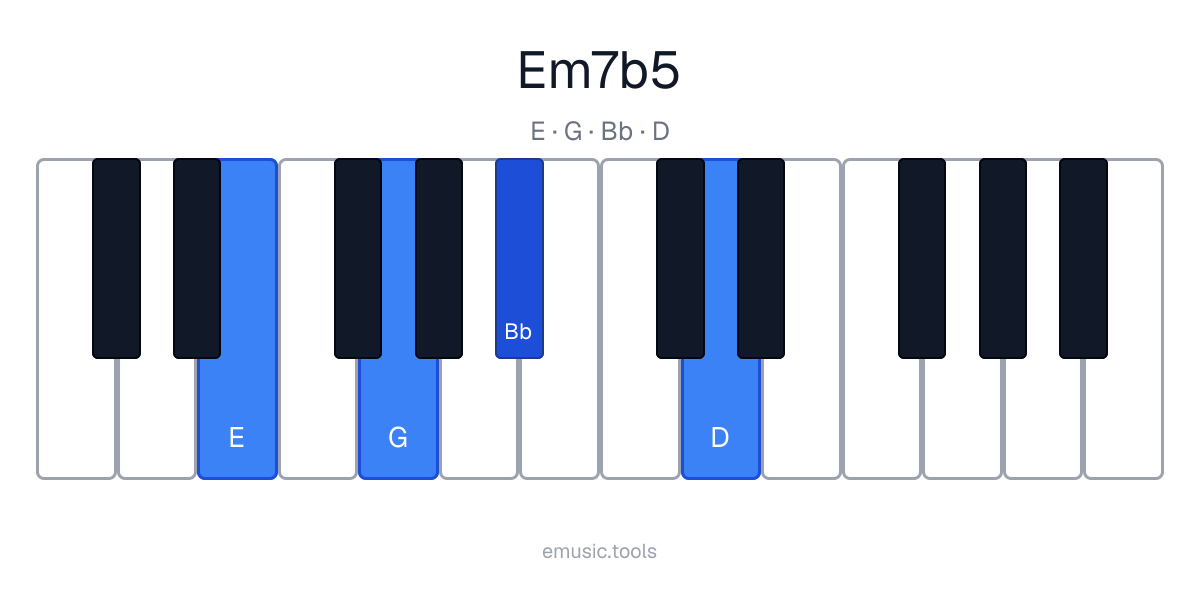
Switch to the interactive diagram to hear the chord, change voicing and swap finger numbers for note names.
To play Em7♭5 on piano, place your right hand with your thumb on E, index finger on G, middle finger on B♭ and little finger on D. Press the keys together and listen for an even sound. On the keyboard B♭ is a black key and E, G and D are white. Practice moving in and out of the chord slowly, then bring in a metronome.
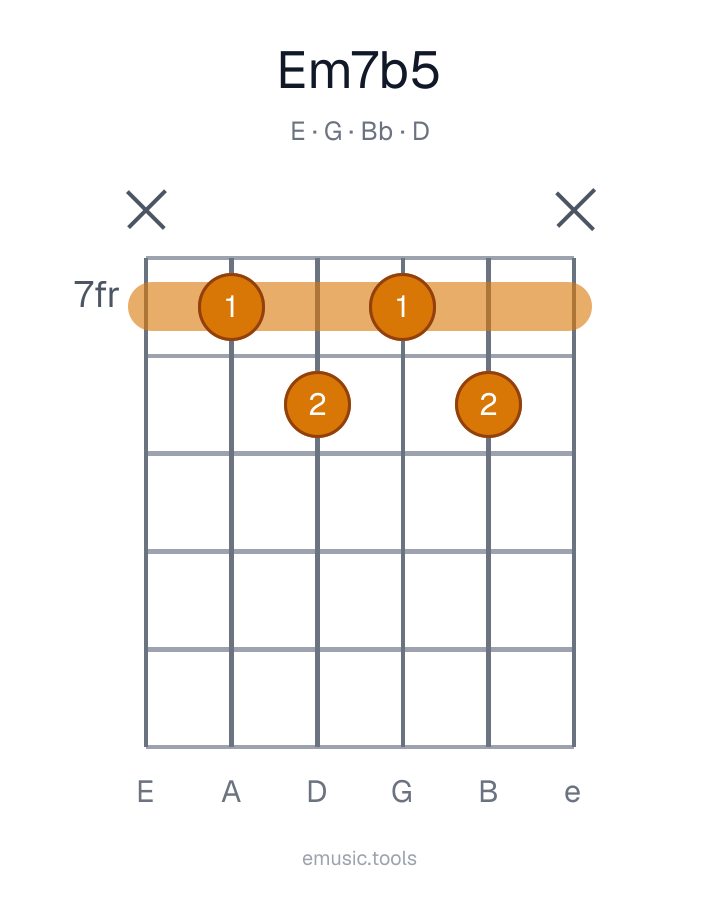
Switch to the interactive diagram to hear the chord, change voicing and swap finger numbers for note names.
On guitar, Em7♭5 is commonly played with the voicing shown above. This one is a barre at fret 7: keep the index finger flat across the strings and curve the others so they don't mute the strings next to them. Don't play strings 6 and 1.
E · G · B♭ · D
Try Em7♭5 on the virtual piano
Free, in your browser: play with the mouse, your computer keyboard or a USB MIDI keyboard. No sign-up.
| Degree | Interval | Semitones | Note | Hear |
|---|---|---|---|---|
| 1 | Root | 0 | E | |
| ♭3 | Minor third | 3 | G | |
| ♭5 | Diminished fifth | 6 | B♭(Bb) | |
| ♭7 | Minor seventh | 10 | D |
The Em7♭5 chord is built from a root, a minor third, a diminished fifth and a minor seventh. Start at the root E and stack the intervals to get the whole chord: E, G, B♭ and D. The same formula gives you the chord in any other key.
Half-diminished chords are most common in jazz standards. They frequently act as the iiø of a minor ii-V-i, leading into the dominant that resolves to a minor tonic.
In major keys Em7♭5 is the viiø7 in F major; in minor keys it's the iiø7 in D minor.
Em7♭5 differs from Em7 by one lowered note, the fifth, and from E°7 by one raised note, the seventh. That in-between position is where the name half-diminished comes from. In a minor key it is the ii chord, so it almost always leads to a dominant seventh.
A half-diminished seventh has one main use: it is the ii of a minor key, leading into the dominant. A major key builds the same chord on its seventh degree.
The minor cadence. Em7♭5 leads into the dominant, and the seventh is what makes it a ii rather than a diminished triad.
The chord a major key builds on its seventh degree, resolving up a semitone onto the tonic.
We use cookies to measure how the site is used and remember your settings. Details in our Privacy Policy.