


E♭ Major Pentatonic at a glance
Major pentatonic is the most singable scale there is. Powers folk, country, gospel, pop melodies and almost every nursery rhyme you've ever heard. Built on the root E♭, the scale takes on the specific colour and pitch range of that key - making it especially useful in genres and registers where E♭ is a comfortable tonal centre.
| Notes | E♭ F G B♭ C |
|---|---|
| Formula | 1P · 2M · 3M · 5P · 6M |
| Step pattern | W W W+H W W+H |
E♭ Major Pentatonic on the piano
Improvisation drone · E♭
Loop the root note as a pad to practice improvising over this scale.
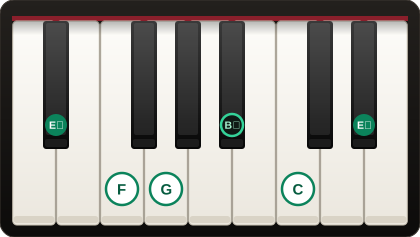
On the piano E♭ Major Pentatonic uses two black keys (E♭ and B♭) and three white.
E♭ · F · G · B♭ · C
Try E♭ Major Pentatonic on the virtual piano
Free, in your browser: play with the mouse, your computer keyboard or a USB MIDI keyboard. No sign-up.
E♭ Major Pentatonic on the guitar
E♭ Major Pentatonic - fr 0–12
E♭ Major Pentatonic on the staff
Notes of the E♭ Major Pentatonic scale
| Degree | Note | Interval | Semitones | Hear |
|---|---|---|---|---|
| 1 | E♭ | unison1P | 0 | |
| 2 | F | major 2nd2M | 2 | |
| 3 | G | major 3rd3M | 4 | |
| 4 | B♭ | perfect 5th5P | 7 | |
| 5 | C | major 6th6M | 9 |
What makes E♭ Major Pentatonic different
The major pentatonic keeps five notes of the major scale and drops the fourth and seventh, the two notes that form its half steps. With no half steps left, no note rubs against another, and any of the five can be held over the tonic chord. That missing tension is what separates it from the full major scale and why it suits vocal melodies, folk tunes and country licks. It has the same notes as the minor pentatonic a minor third below. On E♭, E♭ Major Pentatonic is E♭ Major (E♭ F G A♭ B♭ C D) without A♭ and D.
How to use the E♭ Major Pentatonic scale
Because E♭ Major Pentatonic has fewer or more than seven notes, it doesn't produce a standard set of seven diatonic triads. Instead, build chords by stacking thirds within the scale or use it as a melodic colour over chords drawn from a related diatonic key.
Major pentatonic is the most singable scale there is. Powers folk, country, gospel, pop melodies and almost every nursery rhyme you've ever heard.
Practice tips
Memorise the five-note shape on every string set and sing the notes along with it - this scale was built for making melodies.
Formula & step pattern
The E♭ Major Pentatonic scale follows five notes drawn from the major scale: 1, 2, 3, 5, 6 (skipping the fourth and seventh). Step pattern: W - W - W+H - W - W+H. Intervals from the root: 1P · 2M · 3M · 5P · 6M. Memorising the formula lets you transpose the scale to any other root note quickly.
Where you will hear E♭ Major Pentatonic
Start with the music described above: listen for E♭ Major Pentatonic in it and transcribe a few short phrases by ear. It's the quickest way to learn how the scale sounds.
Questions people ask
What notes are in the E♭ Major Pentatonic scale?
The E♭ Major Pentatonic scale contains E♭, F, G, B♭ and C.
What is the formula for the E♭ Major Pentatonic scale?
E♭ Major Pentatonic follows five notes drawn from the major scale: 1, 2, 3, 5, 6 (skipping the fourth and seventh).
Is E♭ Major Pentatonic a major or minor scale?
E♭ Major Pentatonic is a major pentatonic scale. Five-note bright scale that avoids dissonance - the workhorse of folk, country and pop solos.
What chords belong to the E♭ Major Pentatonic scale?
E♭ Major Pentatonic doesn't produce a standard seven-chord diatonic set. Use chords from a related diatonic scale instead.
Which genres use E♭ Major Pentatonic?
Major pentatonic is the most singable scale there is. Powers folk, country, gospel, pop melodies and almost every nursery rhyme you've ever heard.
How do you play the E♭ Major Pentatonic scale on the piano?
On the piano E♭ Major Pentatonic uses two black keys (E♭ and B♭) and three white.
What is the difference between E♭ Major Pentatonic and E♭ Major?
On E♭, E♭ Major Pentatonic is E♭ Major (E♭ F G A♭ B♭ C D) without A♭ and D.
What is the relative key of E♭ Major Pentatonic?
The relative key of E♭ Major Pentatonic is C Minor Pentatonic. It uses the same notes (C E♭ F G B♭) starting from C, so the two share a key signature.
What is the parallel key of E♭ Major Pentatonic?
The parallel key of E♭ Major Pentatonic is E♭ Minor Pentatonic: the same tonic, E♭, with the notes E♭ G♭ A♭ B♭ D♭.
How do I practise the E♭ Major Pentatonic scale?
Memorise the five-note shape on every string set and sing the notes along with it - this scale was built for making melodies.