


C♯ Harmonic Minor at a glance
Harmonic minor drives Eastern European folk, flamenco, classical music and metal. That raised seventh creates a strong pull to the tonic and gives you a dramatic, exotic feel. Built on the root C♯, the scale takes on the specific colour and pitch range of that key - making it especially useful in genres and registers where C♯ is a comfortable tonal centre.
| Notes | C♯ D♯ E F♯ G♯ A B♯ |
|---|---|
| Formula | 1P · 2M · 3m · 4P · 5P · 6m · 7M |
| Step pattern | W H W W H W+H H |
| Chords in the key | C♯mD♯°E+F♯mG♯AB♯° |
Chords in the C♯ Harmonic Minor scale
These are the chords that naturally form on each degree of the scale. Click a chord to open its dedicated page.
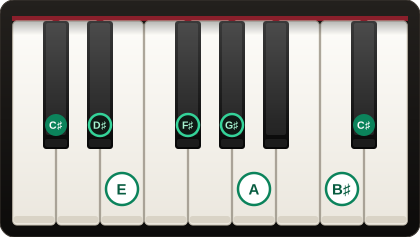
C♯ Harmonic Minor on the piano
Improvisation drone · C♯
Loop the root note as a pad to practice improvising over this scale.
On the piano C♯ Harmonic Minor uses four black keys (C♯, D♯, F♯ and G♯) and three white. B♯ is the white key you'd normally call C.
C♯ · D♯ · E · F♯ · G♯ · A · B♯
Play C♯ Harmonic Minor on the online piano
Free, in your browser: play with the mouse, your computer keyboard or a USB MIDI keyboard. No sign-up.
C♯ Harmonic Minor on the guitar
C♯ Harmonic Minor - fr 0–12
C♯ Harmonic Minor on the staff
Notes of the C♯ Harmonic Minor scale
| Degree | Note | Interval | Semitones | Hear |
|---|---|---|---|---|
| 1 | C♯ | unison1P | 0 | |
| 2 | D♯ | major 2nd2M | 2 | |
| 3 | E | minor 3rd3m | 3 | |
| 4 | F♯ | perfect 4th4P | 5 | |
| 5 | G♯ | perfect 5th5P | 7 | |
| 6 | A | minor 6th6m | 8 | |
| 7 | B♯ | major 7th7M | 11 |
What makes C♯ Harmonic Minor different
Harmonic minor changes a single note of natural minor: the seventh is raised a half step. That note is the leading tone, and it turns the v chord into a major V, which is how classical music in minor keys cadences. It also leaves a gap of three half steps between the sixth and seventh degrees, the augmented second that gives the scale its Middle Eastern and neoclassical sound. Its III chord is augmented, a triad that neither the major scale nor natural minor contains. On C♯, C♯ Harmonic Minor has B♯ where C♯ Natural Minor has B; every other note is shared with C♯ Natural Minor (C♯ D♯ E F♯ G♯ A B).
How to use the C♯ Harmonic Minor scale
The diatonic chords of C♯ Harmonic Minor are: i = C♯m, ii° = D♯°, III+ = E+, iv = F♯m, V = G♯, VI = A, vii° = B♯°. These seven chords belong naturally to the key and are the safest harmonic vocabulary when writing songs in C♯ Harmonic Minor. Each one in the chord table on this page opens its own diagram and progressions.
Harmonic minor drives Eastern European folk, flamenco, classical music and metal. That raised seventh creates a strong pull to the tonic and gives you a dramatic, exotic feel.
Practice tips
Spend extra time on the augmented second between the sixth and seventh degrees - that interval is the scale’s emotional fingerprint. Drill it slowly, then in scale runs.
Formula & step pattern
The C♯ Harmonic Minor scale follows the natural minor pattern with a raised seventh, creating an augmented second between the sixth and seventh degrees. Step pattern: W - H - W - W - H - W+H - H. Intervals from the root: 1P · 2M · 3m · 4P · 5P · 6m · 7M. Memorising the formula lets you transpose the scale to any other root note quickly.
Where you will hear C♯ Harmonic Minor
Start with the music described above: listen for C♯ Harmonic Minor in it and transcribe a few short phrases by ear. It's the quickest way to learn how the scale sounds.
Questions people ask
What notes are in the C♯ Harmonic Minor scale?
The C♯ Harmonic Minor scale contains C♯, D♯, E, F♯, G♯, A and B♯.
What is the formula for the C♯ Harmonic Minor scale?
C♯ Harmonic Minor follows the natural minor pattern with a raised seventh, creating an augmented second between the sixth and seventh degrees.
Is C♯ Harmonic Minor a major or minor scale?
C♯ Harmonic Minor is a harmonic minor scale. Natural minor with a raised seventh, creating a dramatic, eastern feel.
What chords belong to the C♯ Harmonic Minor scale?
The diatonic chords of C♯ Harmonic Minor are C♯m, D♯°, E+, F♯m, G♯, A, B♯°.
Which genres use C♯ Harmonic Minor?
Harmonic minor drives Eastern European folk, flamenco, classical music and metal. That raised seventh creates a strong pull to the tonic and gives you a dramatic, exotic feel.
How do you play the C♯ Harmonic Minor scale on the piano?
On the piano C♯ Harmonic Minor uses four black keys (C♯, D♯, F♯ and G♯) and three white. B♯ is the white key you'd normally call C.
What is the difference between C♯ Harmonic Minor and C♯ Natural Minor?
On C♯, C♯ Harmonic Minor has B♯ where C♯ Natural Minor has B; every other note is shared with C♯ Natural Minor (C♯ D♯ E F♯ G♯ A B).
How do I practise the C♯ Harmonic Minor scale?
Spend extra time on the augmented second between the sixth and seventh degrees - that interval is the scale’s emotional fingerprint. Drill it slowly, then in scale runs.