


As the tonic (I)G♯ major
Home. The loop leaves G♯ Major and keeps coming back to it.
The G♯ Major chord is built on the root note G♯. Its notes are G♯, B♯ and D♯. It's enharmonically the same chord as A♭ Major.
Major chords feel bright, stable and resolved. A root, a major third and a perfect fifth give them a happy, confident sound. Most popular music is built on them.
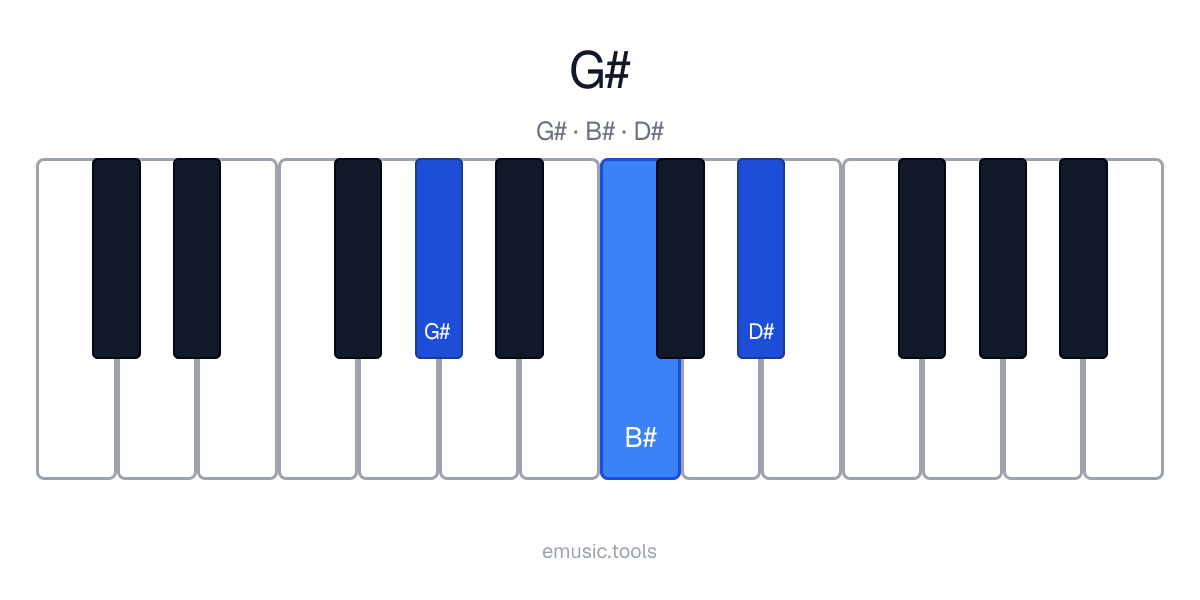
Switch to the interactive diagram to hear the chord, change voicing and swap finger numbers for note names.
To play G♯ Major on piano, place your right hand with your thumb on G♯, middle finger on B♯ and little finger on D♯. Press the keys together and listen for an even sound. Practice moving in and out of the chord slowly, then bring in a metronome.
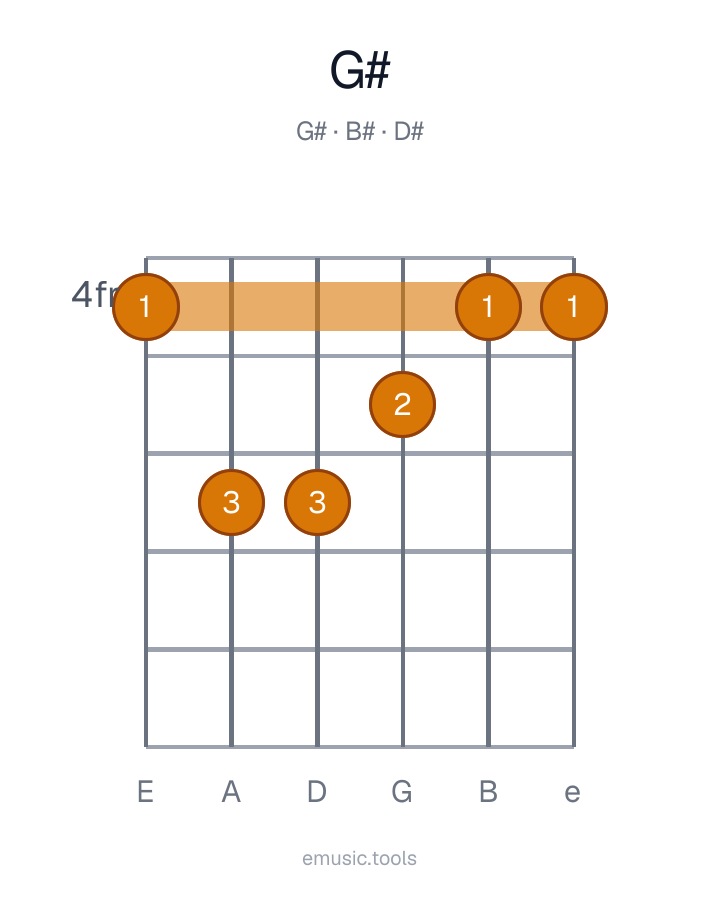
Switch to the interactive diagram to hear the chord, change voicing and swap finger numbers for note names.
On guitar, G♯ Major is commonly played with the voicing shown above. This one is a barre shape: keep the index finger flat across the fretboard and curve the others so they don't mute the strings next to them. Strum only the strings marked as active in the diagram.
Also known as A♭ Major
| Degree | Interval | Semitones | Note | Hear |
|---|---|---|---|---|
| 1 | Root | 0 | G♯(G#) | |
| 3 | Major third | 4 | B♯(B#) | |
| 5 | Perfect fifth | 7 | D♯(D#) |
The G♯ Major chord is built from a root, a major third and a perfect fifth. Start at the root G♯ and stack the intervals to get the whole chord: G♯, B♯ and D♯. The same formula gives you the chord in any other key.
You'll find major chords in almost every style of popular music: rock anthems, country ballads, pop hits and hymns. They commonly appear as the I, IV and V chords in a major key.
A major chord is at home as a tonic, and just as useful as the IV or the V of a neighbouring key. Each progression below is written in the key its numerals name.
Home. The loop leaves G♯ Major and keeps coming back to it.
G♯ Major is the step away from home that makes the return feel like a return.
G♯ Major is the chord that wants to resolve, so ending the loop on it hands straight back to the top.
These scales include G♯ as one of their diatonic chords. Use them to find melodies and improvisation ideas that fit perfectly.
We use cookies to measure how the site is used and remember your settings. Privacy Policy.