


Guitar and piano usually get taught as if a scale on one had nothing to do with the other, and anyone who switches between them knows how that feels. The Scale Finder puts both on one screen. Pick a root note and one of 34 scale types, and it draws the scale on a two-octave piano keyboard and a guitar fretboard at the same time, plays it back, and lists the chords built from it.
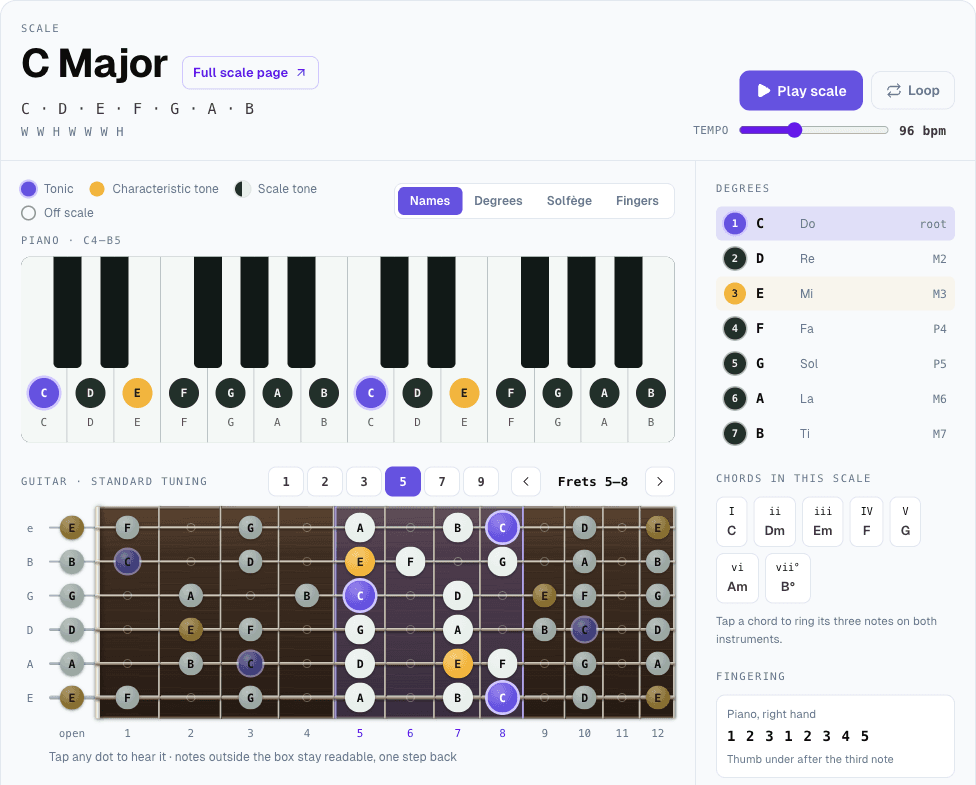
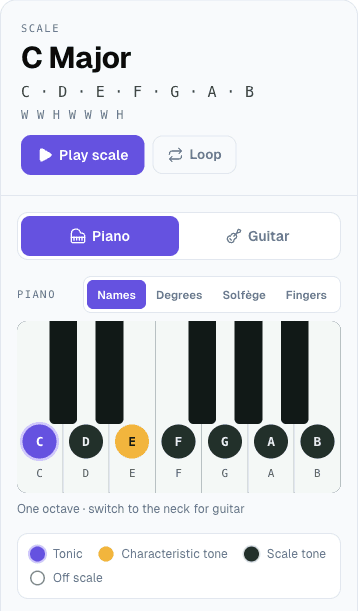
The default view is C Major. Both instruments mark the same seven notes in the same colors: the root in violet, a characteristic tone in amber, the other scale notes in dark grey, and every note outside the scale as an empty outline. "Play scale" runs up the scale at the tempo you set (50 to 180 bpm, 96 by default), and turning "Loop" on before you press it keeps it repeating. Tapping any dot on either instrument plays that one note, whether or not the scale is running.
Tap a chord, hear it on both instruments
For seven-note scales the right-hand rail lists the diatonic chords: roman numerals I to vii° for a major scale, with the chord symbol under each (I is C, vi is Am). Tap one and its three notes ring on the piano and the fretboard together while everything outside the chord dims, so you can see which notes an Am from this key is made of.
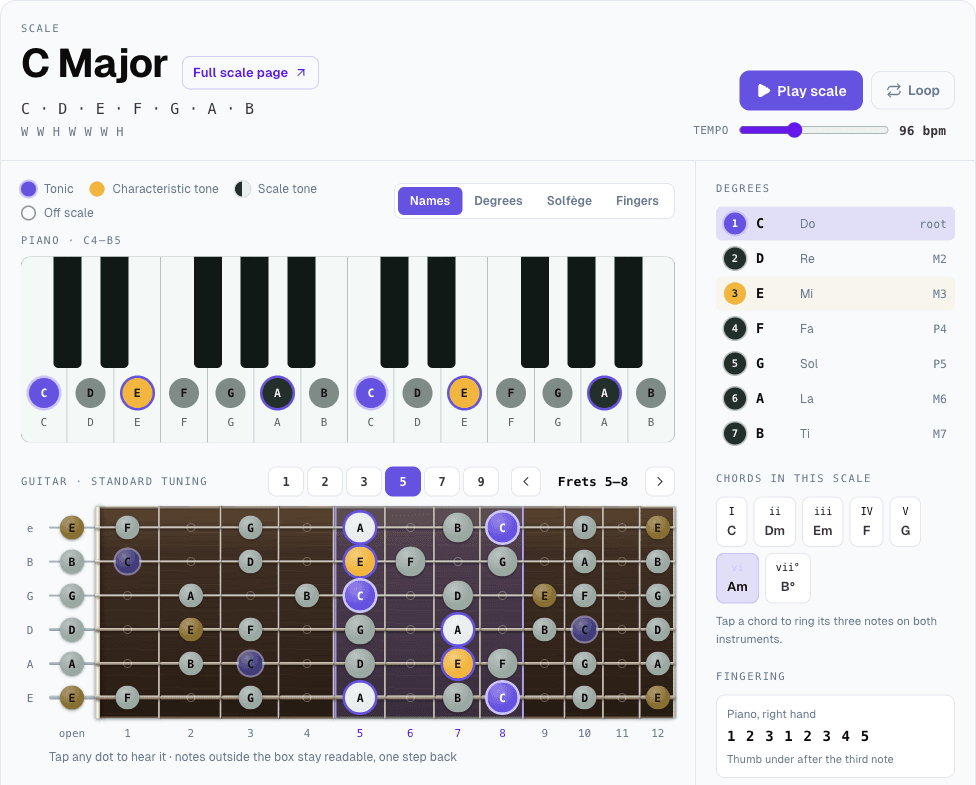
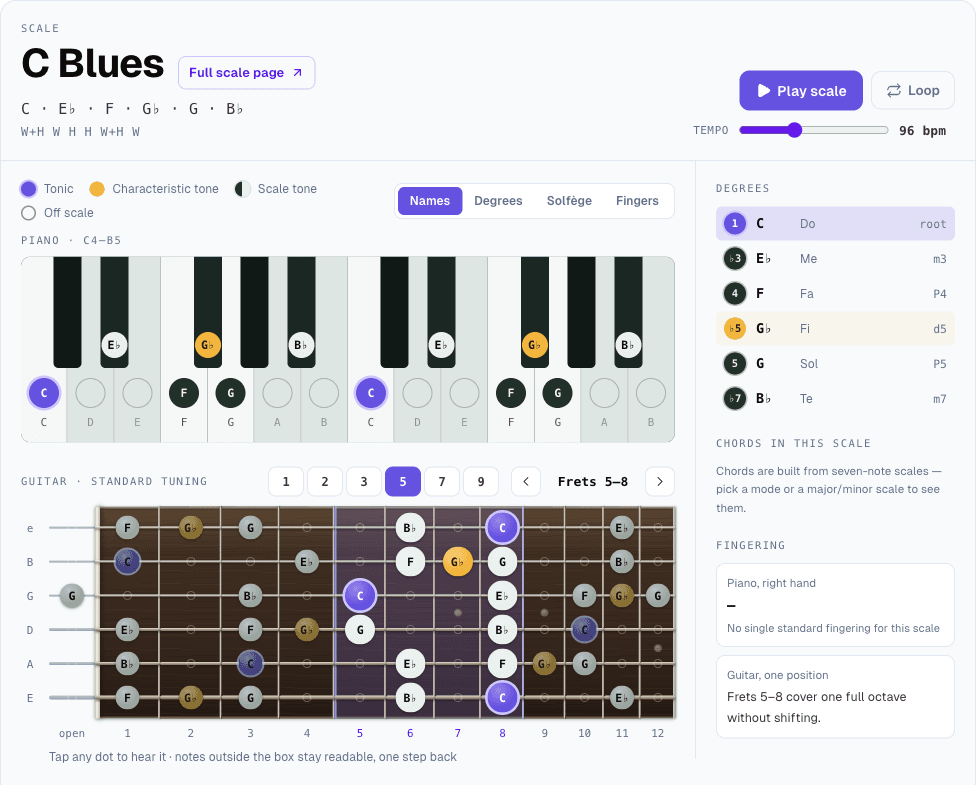
A triad needs a seven-note scale to be built from, so the pentatonic and symmetric groups get no chords, while the exotic scales, all of them seven-note, do. Switch to a six-note scale like Blues and the rail shows a short note in place of the chords: they come from seven-note scales, so pick a mode or a major or minor scale to see them. The tool says so instead of quietly hiding the section.
34 scale types in five groups
Under the instruments are 12 root buttons and five groups of scales. Major & minor. Modes, from Dorian to Locrian plus Lydian Augmented, Lydian Dominant, Hindu and Altered (Ionian and Aeolian are the Major and Natural Minor buttons). Pentatonic & 5-note, with the two pentatonics, Egyptian, the six-note Blues and four Japanese scales. Symmetric & 8-note: Whole Tone, Half-Whole Diminished, Bebop Dominant and Chromatic. Exotic, which holds Hungarian Minor, Persian and others. A sharp/flat toggle next to the roots re-spells the whole scale, so F♯ becomes G♭ and the highlighted notes stay the same.
Four ways to label the same dots
Four buttons above the piano change the text on every marked note. Names gives C, D, E. Degrees gives 1, 2, 3, with accidentals on altered tones. Solfège is movable Do, so the root is always Do. Fingers puts right-hand fingering on the white piano keys and, on the guitar, finger numbers counted from the first fret of the position box. Piano fingering shows up only when the root is a white key and the scale has a standard fingering. With a black-key root the keys keep their note names and the fingering panel shows a dash.
A position box that moves along the neck
On a desktop the fretboard shows the scale across 12 frets and shades a four-fret window on it, a position. The buttons jump the window to fret 1, 2, 3, 5, 7 or 9, and the arrows nudge it one fret at a time. Notes outside the window stay readable but step back, so you can see where the pattern goes next without it competing with the box you're practicing. The side panel says what the window covers, for example that frets 5 to 8 cover one full octave without shifting your hand. For five-note scales it gives the pentatonic version of the same line.
On a phone, one instrument at a time
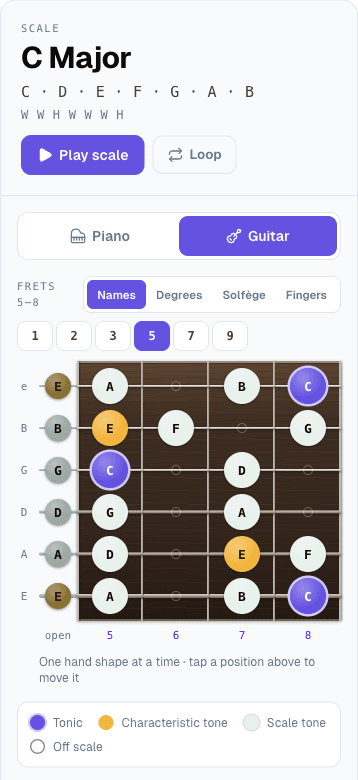
A phone shows one instrument at a time through a Piano / Guitar switcher, and the tool remembers your choice in your browser. The piano drops to a single octave with a hint pointing you to the guitar, and the guitar shows only the open strings and the four frets of the current position instead of the whole neck. The phone layout leaves out the chord chips, the fingering panel and the tempo slider, but keeps "Play scale" and "Loop".
When a scale has a page in the Scale Library, a "Full scale page" link next to the title opens it. The tool is free, needs no account and has no Pro limit. If you know a scale by name but have never seen where it sits on both of your instruments at once, open the Scale Finder and pick a root.


