


A printed score says "Allegro," not "132 BPM." That's deliberate, since a tempo marking describes a character as much as a speed, but it leaves you with a real question the first time you sit down to play the piece. The musical terms dictionary answers it: fifteen Italian tempo words, each with the BPM range it usually covers, plus 146 more terms for everything else printed around them.
Type the whole marking, not one word
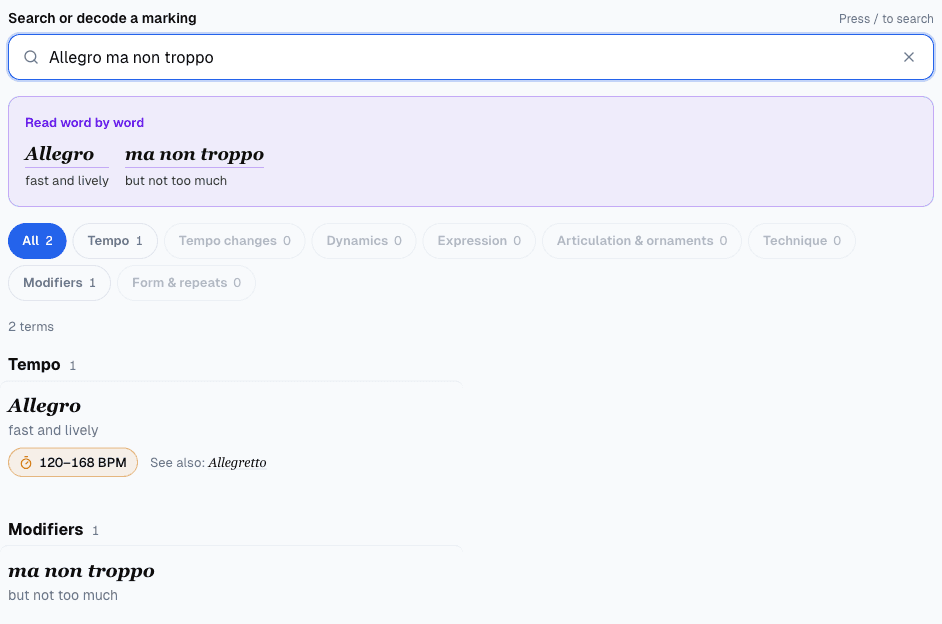
Scores rarely print one word on its own. You get "Allegro ma non troppo" or "Andante con moto", a tempo with a modifier and a character stacked on top. Paste the whole thing into the search box and the dictionary reads it word by word: each term with its meaning underneath, and small connecting words like ma (but) and non (not) glossed too. The matching cards show up below, sorted into eight categories: Tempo, Tempo changes, Dynamics, Expression, Articulation & ornaments, Technique, Modifiers, and Form & repeats.
Fifteen tempo words on one BPM axis
Grave sits at 20 to 40 BPM, Largo 40 to 60, Lento 45 to 60, Larghetto 60 to 66, Adagio 66 to 76, Adagietto 70 to 80, Andante 76 to 108, Andantino 80 to 108, Moderato 108 to 120, Allegretto 112 to 120, Allegro 120 to 168, Vivace 168 to 176, Vivacissimo 172 to 176, Presto 168 to 200, and Prestissimo starts at 200 with no ceiling. The tempo ladder on the page draws them all as bars on one axis, so you can see where they overlap. Adagietto straddles Adagio and Andante, and Vivace, Vivacissimo and Presto all claim ground around 170. That isn't a mistake in the reference. A slow Allegro and a brisk Vivace can land on the same number, and the difference is in how the music is played.
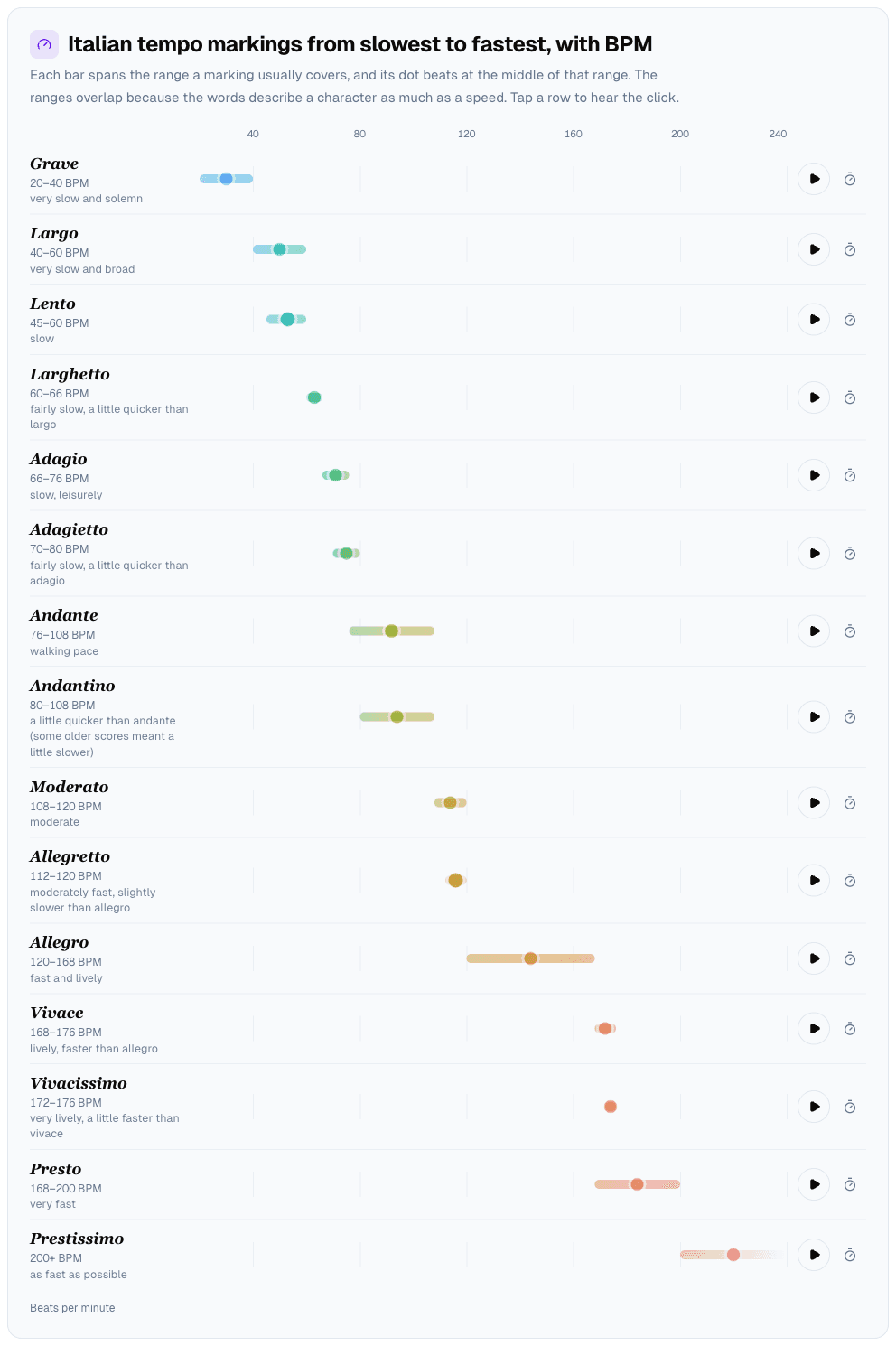
Colour follows speed, from blue at Grave to red at Prestissimo, and the BPM chips on the dictionary cards use the same scale. Each bar has a dot beating at the middle of its range. Press play on a row to hear that marking as a click, and the metronome icon next to it opens the metronome already set to that BPM. Treat the midpoint as a place to start, then adjust by ear.
Metronome Tempo
Tempo refers to the speed at which a musical piece is performed. It's measured in beats per minute (BPM) and can significantly influence the character of a composition. Select a tempo to see more details.
Largo
40-60 BPMExtremely slow tempo emphasizing weight and gravity.
Adagio
66-76 BPMCalm and soothing tempo, conducive to reflection.
Andante
76-108 BPMA natural pace similar to human walking - balanced and calm.
Moderato
108-120 BPMA versatile tempo - neither lazy nor rushed.
Allegro
120-168 BPMLively, driving tempo - sets the rhythm for the body and heart.
Presto
168-200 BPMExpression, virtuosity, and adrenaline - extreme tempo.
Tips
Start Slowly
Begin at a comfortable tempo and gradually increase speed, building accuracy and confidence.
Be Consistent
Focus on maintaining a steady tempo rather than playing fast. Consistency matters more than speed.
Use Subdivisions
Practice counting subdivisions (eighths, sixteenths) to improve your sense of rhythm.
Words that change the tempo instead of setting it
Eighteen terms get their own category because they describe a change, not a speed. Accelerando and stringendo speed up (stringendo with rising tension), ritardando and rallentando slow down gradually, ritenuto holds back at once, and allargando broadens and usually gets louder. Più mosso and meno mosso mean faster and slower than before. A tempo sends you back to the tempo before the last change, Tempo primo to the one at the opening. Rubato, ad libitum and a piacere hand the timing to you. On the page they're grouped by direction under coloured headings (Faster, Slower, Back to tempo and Free), and each card has a stripe in its group's colour, so you can tell rit. from accel. before reading the meaning.
The rest of what's printed around the tempo mark
Dynamics have a ladder of their own, eight levels from pianississimo to fortississimo on the same blue-to-red scale, and tapping one plays the same note at that level. Expression words say how to play (cantabile, dolce, grazioso, maestoso and plenty more), articulation covers the shape of single notes, and form marks like Da capo, Dal segno, Fine and Coda tell you where to go next. At the bottom of the page there's a quiz: one term, four meanings, drawn from the whole dictionary or from a category you pick. It's handy the night before a theory exam.
You don't need to learn any of this in one sitting. Search the marking on the page in front of you, and the musical terms dictionary will be there the next time a score gives you a word instead of a number.
Cover photo: Nikko mechanical metronome, by Vincent Quach (Invincible), CC BY-SA 3.0, via Wikimedia Commons, cropped and resized.


