


A perfect fifth sounds like the first two notes of "Twinkle, Twinkle, Little Star." A perfect fourth sounds like the first two notes of "Here Comes the Bride." Once you've heard that connection, it's hard to unhear it, and that's the whole idea behind the interval song chart: thirteen intervals, from a unison up to an octave, each with a handful of well-known songs whose opening notes outline it exactly.
Here's how the chart is laid out, how to actually make one of these mnemonics stick, and how to pair it with the Interval Finder so you end up recognizing the interval, not just the song.
What's on the chart
Every card is one interval: a name, a semitone count, a short code like P4 or m3, and two small buttons that play the interval up or down so you can check your ear before committing to anything. Below that sits a list of songs, and each one carries an arrow. An up arrow means the second note of the song is higher than the first; a down arrow means it drops.
The Perfect 4th card is a good place to start because it leans hard in one direction. Wagner's bridal march, "Here Comes the Bride," climbs a fourth right out of the gate. So does "Amazing Grace." Out of seven songs on that card, only Mozart's "Eine Kleine Nachtmusik" opens by falling a fourth instead of rising one.
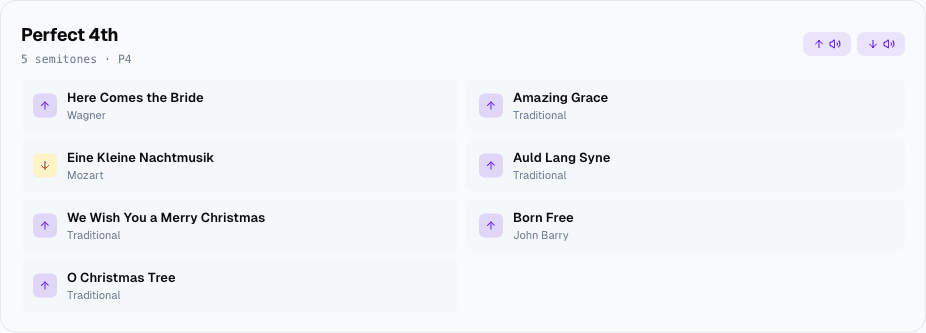
The same interval can climb or fall
Other intervals split more evenly, and the Major 3rd card is the clearest example. "When the Saints Go Marching In" rises a third. "Summertime," "Swing Low, Sweet Chariot" and the opening of Beethoven's Fifth all fall one. Same distance between the two notes, opposite direction, and a completely different feeling once you hum them back to back.
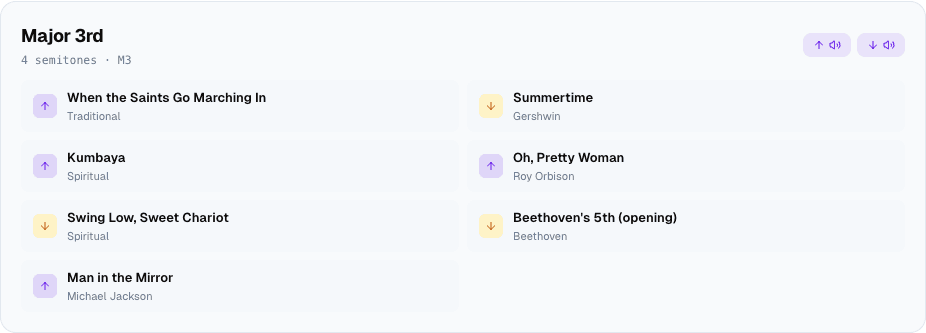
That's the reason the chart plays both directions instead of one. An interval you can only recognize going up is half an interval. Press the down arrow on a card a few times before you move on, and check that the falling version rings a bell too.
How to actually make it stick
Pick one card. Listen to the song's opening, hum it back, then say the interval's name out loud - not in your head, out loud. Do that for the same interval every day for a week. Most people stop needing the song after roughly twenty repetitions: the interval starts to sound like itself, and the song title only shows up afterward, as confirmation rather than as the way you got there.
Don't worry if you don't know one of the listed songs. The mnemonic only works if it's instantly recognizable to you, so swap in anything from your own listening that opens with the same two notes. A film theme, a jingle, a song from a completely different genre - it doesn't matter, as long as you know it cold.
From song to interval: the Interval Finder
The chart is a reference. The Interval Finder is where the recognition actually gets tested. Its Explorer tab lets you click any two notes on a keyboard and see everything about the interval between them: the name, the enharmonic spelling, what it becomes when you invert it, a consonance-to-dissonance readout with the just-intonation ratio behind it, and the same song mnemonics from the chart, with a link back in case you want the full list.
The tab next to it is the actual quiz. Pick a difficulty - common intervals (minor and major 2nds and 3rds, the perfect 4th, 5th and octave) or all twelve, tritone and both flavors of 6th and 7th included. Pick a direction: harmonic plays both notes at once, melodic plays them one after another, ascending or descending. Then it's multiple choice: listen, name the interval, and the audio repeats either way so a wrong guess still trains your ear.
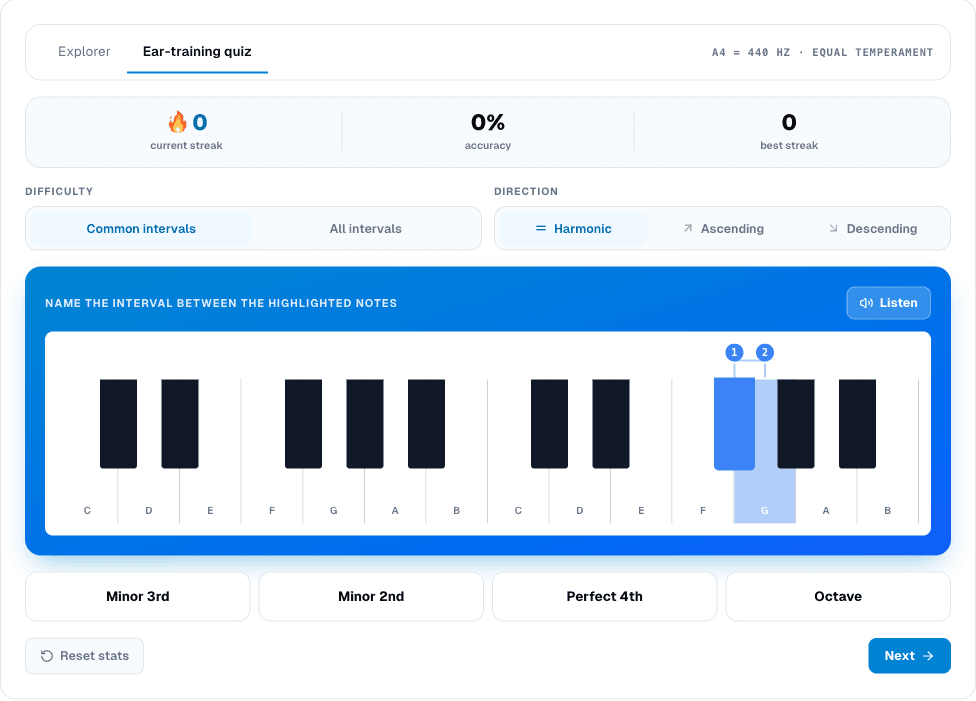
The three stats above the question - current streak, accuracy, best streak - reset only if you ask them to, and every answer here also counts toward the same "intervals" skill tracked on the ear-training dashboard, so a few minutes on the quiz shows up in your overall practice history, not in a separate scoreboard nobody looks at.
Start on the interval song chart, pick two or three intervals that keep confusing you, and give them a week of thirty-second sessions. That's a smaller commitment than it sounds, and it's the part that actually works.
Cover photo: piano keyboard closeup, by Raysonho @ Open Grid Scheduler / Grid Engine, public domain (CC0), via Wikimedia Commons, resized.


