


Key Signatures has two tabs. The Explorer lists all 30 major and minor keys, fifteen of each, grouped by how many sharps or flats they carry. The Trainer quizzes you on the link between a key and its signature, in either direction. If you want the wheel with sound, that's the Circle of Fifths, a separate tool.
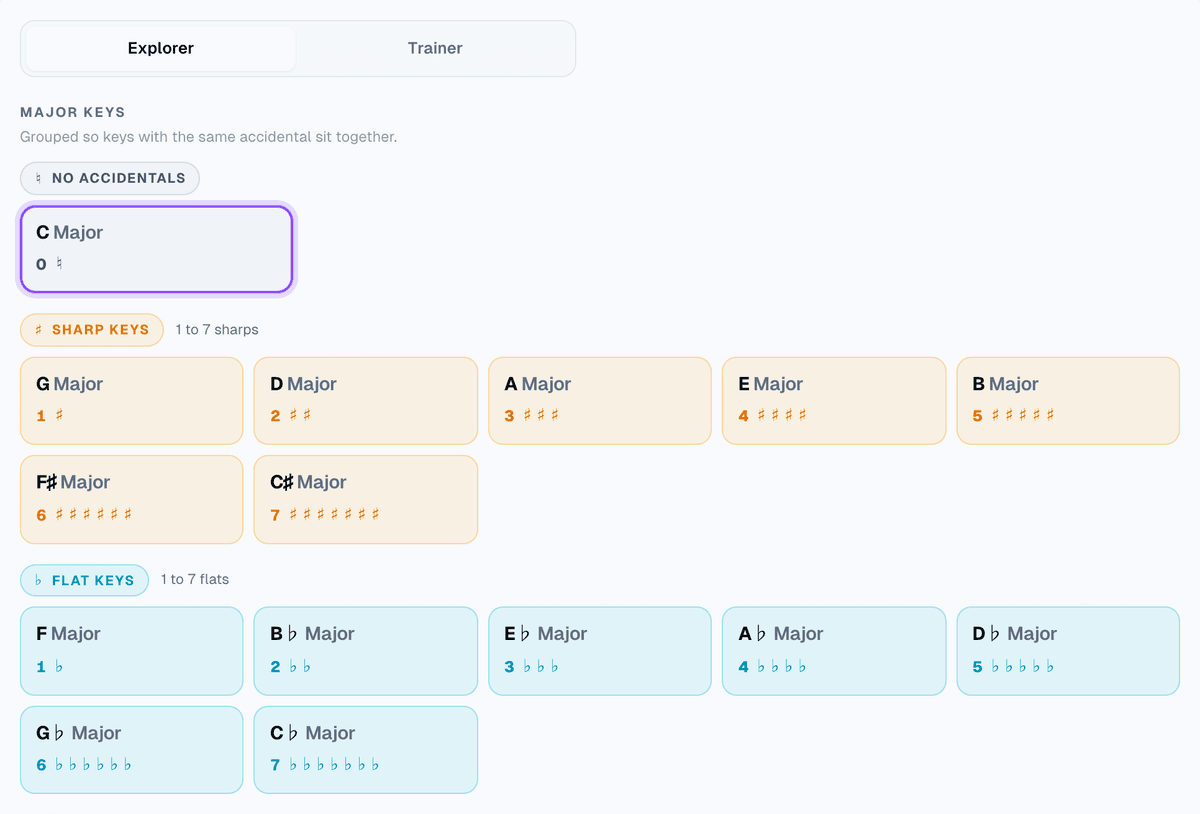
Thirty keys, three bands
The Explorer opens on C major. Every major key sits in one of three bands: no accidentals, 1 to 7 sharps, 1 to 7 flats. Enharmonic pairs get a card each, so D♭ major (five flats) and C♯ major (seven sharps) are both there, and so are G♭ and F♯, C♭ and B. The minor keys repeat the layout underneath.
Click a card and the detail panel at the bottom changes to that key. You get its seven notes with the altered ones highlighted, the number of accidentals and which ones they are, and two links.
Relative and parallel keys, one click away
Click G Major. F♯ lights up among the notes, the panel says "1 sharp", and the links read E Natural Minor (the relative key, same signature) and G Natural Minor (the parallel key, same tonic, two flats instead of one sharp). Below them are the seven diatonic chords with their Roman numerals: G, Am, Bm, C, D, Em and F♯°.
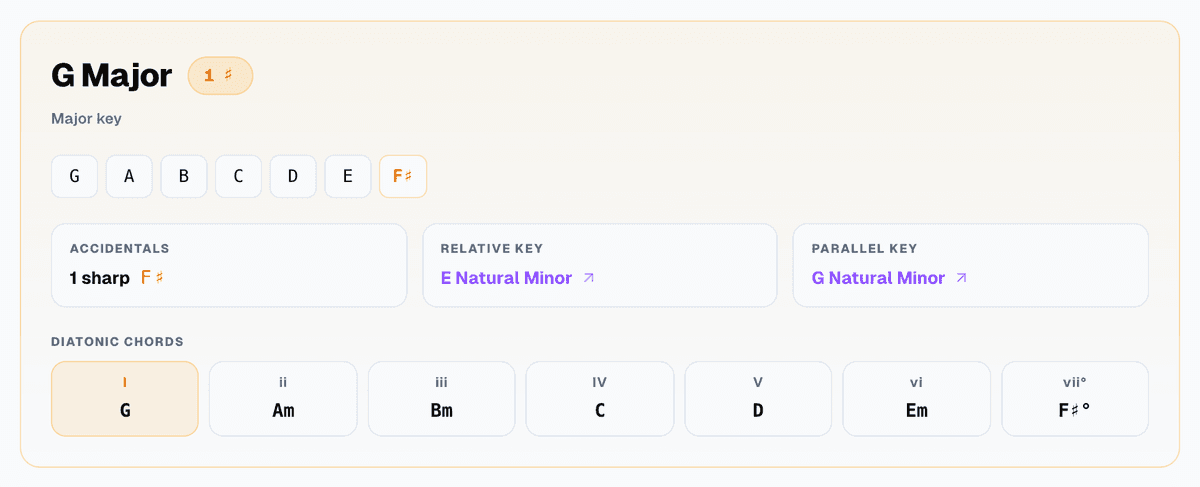
Both links jump the Explorer to that key, so you can walk from G major to E minor, on to E major and back without hunting through the grid. The chords aren't clickable. For voicings there's a link to the Chord Library at the bottom of the page.
The quiz goes both ways
The Trainer starts in Count accidentals mode: "How many accidentals does this key have?", a key name, and four counts to pick from. Switch Mode to Identify key and the question flips. Now you see a signature, a number and a sharp or flat sign, and pick the key that owns it from four names.
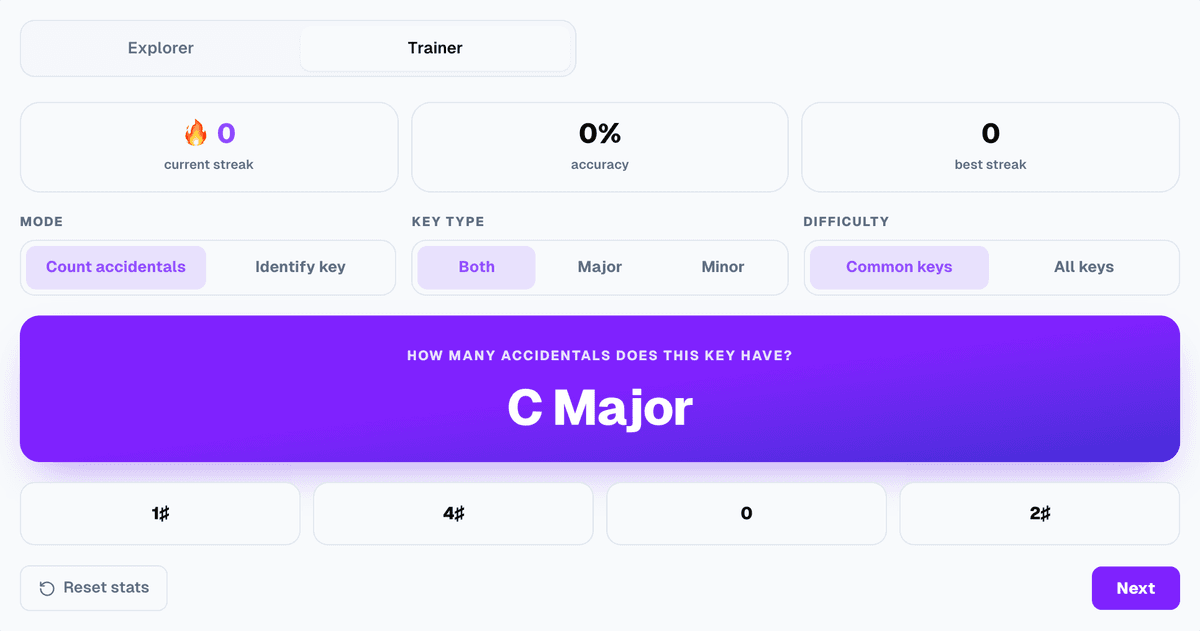
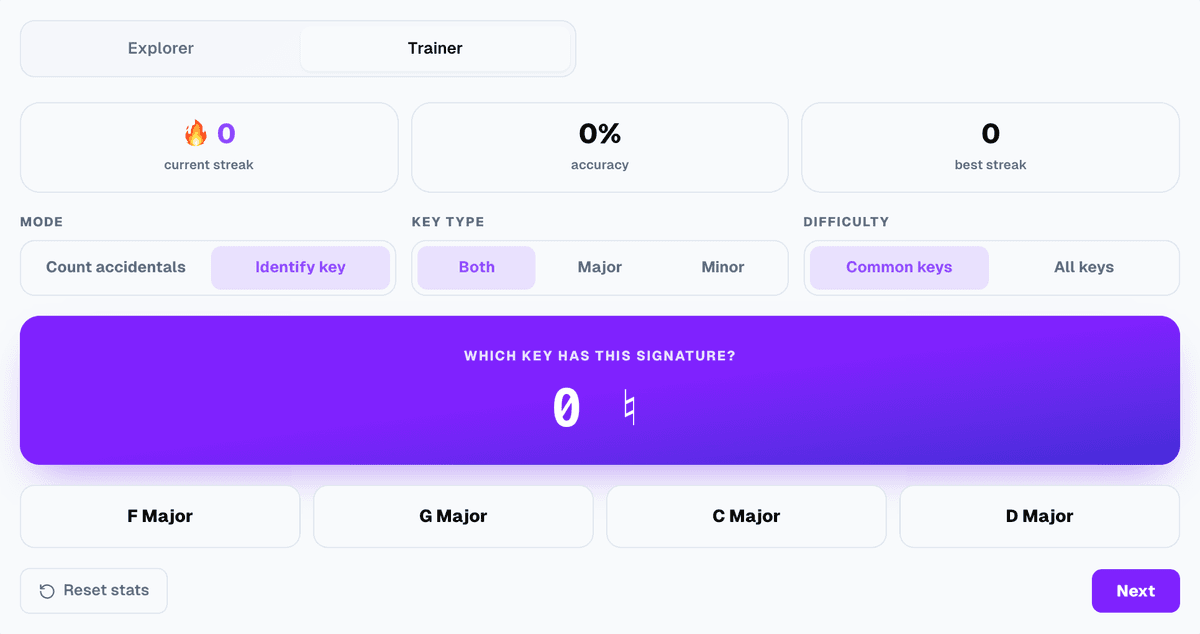
Key type (Major, Minor or Both) and Difficulty (Common keys or All keys) set the pool whichever mode you're in. Common keys means eight major keys (C, G, D, A, E, F, B♭, E♭) and six minor ones (A, E, B, D, G, C). All keys is the full fifteen of each, which is where C♭ and A♯ minor start turning up.
Why both directions? Counting from a key name is recall. Naming the key from a bare signature is the lookup you need when a piece opens with three flats and you haven't read a note yet. They feel like the same fact until you try the second one.
The order of accidentals, drawn as stairs
Most people learn "Father Charles Goes Down And Ends Battle" as a sentence and nothing else. Further down the page, the Order of accidentals section draws it as two staircases of seven steps. Each step adds one sharp or flat and highlights it, so a key with three sharps uses the first three steps: F♯, C♯, G♯.
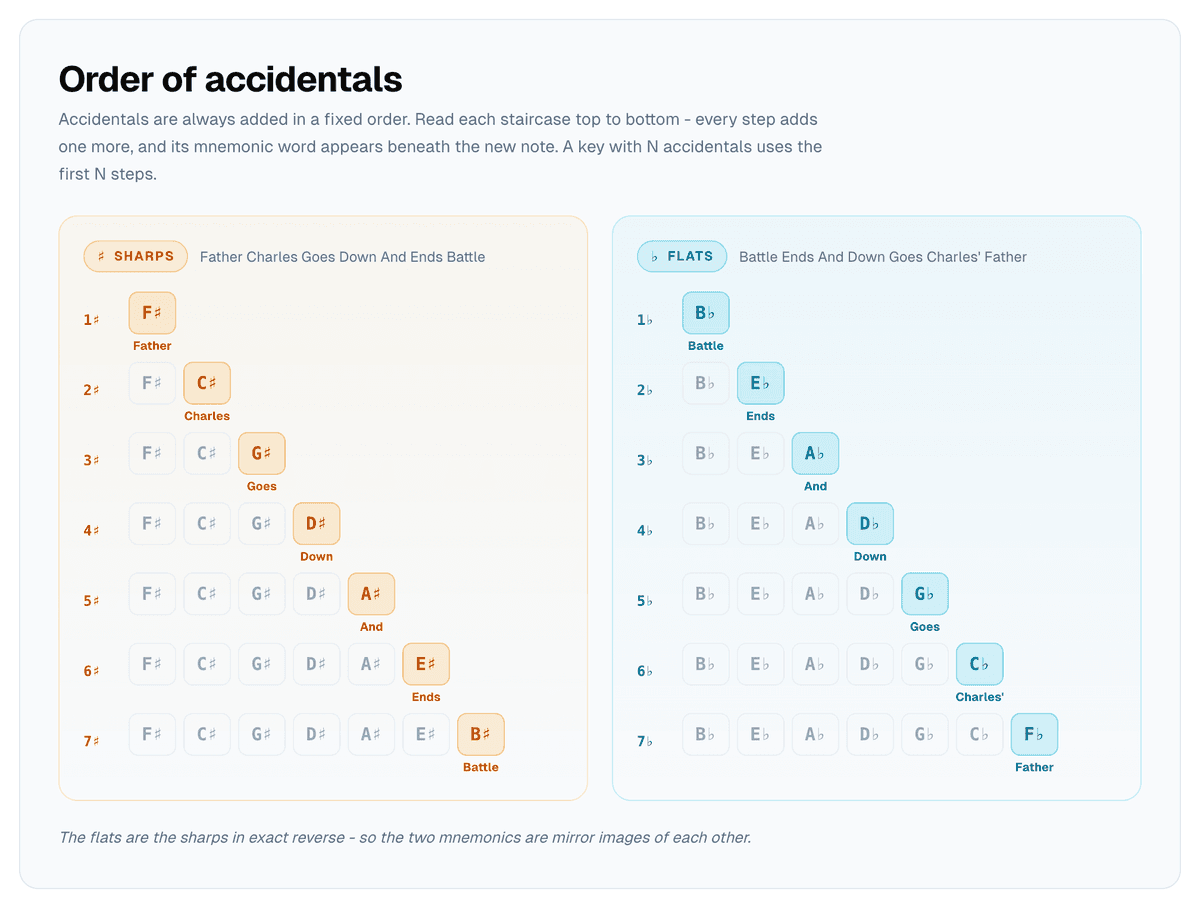
The flats are the sharps backwards: B♭ E♭ A♭ D♭ G♭ C♭ F♭ against F♯ C♯ G♯ D♯ A♯ E♯ B♯. Once you see that, you only have to learn one sentence.
The tool is free, keeps your streak and accuracy in the browser, and has no Pro limit. Open Key Signatures and start with G major.


