


Almost every tuner you have used made two decisions for you before you played a note. It decided that the A above middle C is 440 Hz, and it decided that the octave splits into twelve exactly equal steps. Both are conventions, and neither is much more than a century old.
Most of the time you should leave them alone. But if you play with a baroque ensemble, record against a track that was cut sharp, follow a luthier's intonation chart, or just want to hear what "just intonation" sounds like, you need a tuner that lets you move them. That is what the advanced tuner is for.
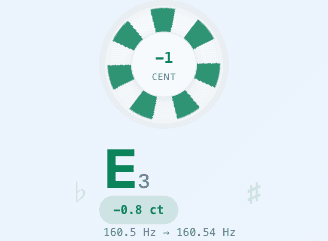
The strobe dial: in tune means stopped
The wheel in the corner copies a mechanical strobe tuner, which spins a slotted disc under a lamp flashing at the note's frequency. When the two agree, the pattern appears to stand still. This one does it without the hardware: the spokes rotate at a speed proportional to how far off you are, and in the direction of the error. Flat spins one way, sharp the other, and the closer you get the slower it goes.
It is worth getting used to, because it beats a needle over the last few cents. A needle at −2 cents and a needle at 0 look almost identical. A wheel creeping round is obviously still moving.
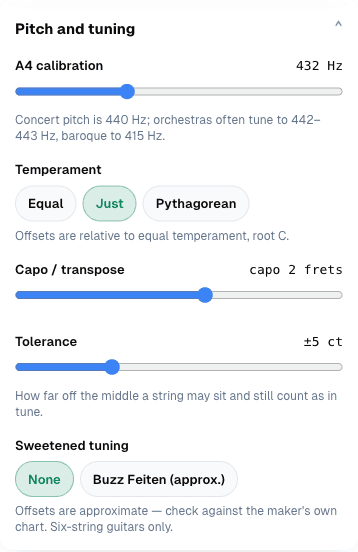
A4: where the whole system is anchored
Everything else is measured from one reference pitch, and the tuner puts it on a slider from 415 to 466 Hz.
- 440 Hz is the ISO standard, set in 1955, and what you want unless you have a reason not to.
- 442 to 443 Hz is where many European orchestras actually sit. It sounds brighter, and it is why your 440 tuner disagrees with the oboe.
- 415 Hz is baroque pitch, near enough a semitone below concert. Historical ensembles use it so gut strings sit at a sane tension.
- 432 Hz has a following. The claims made for it are not supported by evidence, but the tuner will not argue: it sits about 32 cents below 440, roughly a third of a semitone, and your guitar will not mind.
Moving that slider moves every target frequency at once, and the string pads update to match. Set A4 to 432 and the low E stops being 82.41 Hz and becomes 80.91.
Temperaments: the twelve steps are not equal
Equal temperament divides the octave into twelve identical steps. It is a compromise that makes every key equally usable by making every key equally slightly out of tune. Two older systems are on offer here, both measured against equal temperament with C as the root.
- Just intonation tunes intervals to whole-number frequency ratios. The major third comes out about 14 cents flat of equal, which is why a just major chord sounds calmer than a piano one. The catch is that it only works in one key at a time.
- Pythagorean builds everything from stacked perfect fifths. The fifths are pure; the thirds are wide and restless. It suits medieval and early Renaissance repertoire, and fiddle players often drift towards it without being told to.
Pick one and watch the string pads move. On a standard guitar in just intonation the G string target shifts by a couple of cents and the B string by rather more. That is the tuning system, not the tuner being wrong.
What the capo slider changes
A capo raises every string by the same number of semitones, so the note names change and so do the target frequencies. Set the slider to 2 and standard E A D G B E becomes F♯ B E A C♯ F♯: the tuner now expects the second fret to be your open string, and the readout says so. Negative values do the opposite, for anyone tuned down a semitone or two.
Tolerance: what "in tune" means
The tolerance slider decides how close counts. The default ±5 cents is a sensible working figure for a guitar in a room. Tighten it to ±2 for recording and you will notice how much harder it is to hold. Loosen it to ±10 and the green window on the strip meter widens to match.
The two graphs
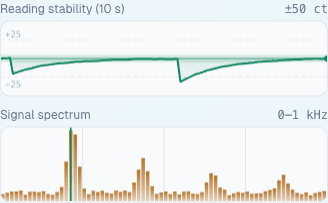
Under the meter are ten seconds of reading history and a live spectrum. The stability trace is the more useful of the two: a string that reads dead-on but wanders has not settled yet, and you can watch it settle. What you want is a trace that dips when you touch the peg and then holds flat.
The spectrum is a diagnostic. If the tuner keeps insisting your low E is an E3, the spectrum shows why: the fundamental is weak and the second harmonic is carrying the note. Pluck nearer the bridge, or lock the string manually and let the tuner snap to its octave.
Input level
The level meter has a line near the top for a reason. Pitch detection on a clipped signal is worse than on a quiet one: a squared-off waveform is full of harmonics that were never in the string. If the meter is pinned and the readout is jumping around, move away from the microphone rather than closer.
Which one should you use?
If you are tuning a guitar before playing, use the simple tuner. It has the same detector and the same reference tones, without any of this in the way.
Come here when the question has stopped being "is this string in tune" and become "in tune to what": a baroque programme, an orchestra at 442, a recording that was sped up, a luthier's chart, or curiosity about how a just major third really sounds.
Both run entirely in your browser. No audio is sent anywhere, and once the page has loaded you can go offline and keep tuning.


