


As a minor tonicG minor
The natural-minor loop - every chord is drawn from the key's own seven notes.
The Gm6 chord is a minor sixth chord built on the root note G. Its notes are G, B♭, D and E.
Minor sixth chords are darker than a plain minor triad but never sour. A major sixth sitting over a minor third gives them a wistful, cinematic quality that turns up in bossa nova, French chanson and film noir scores.
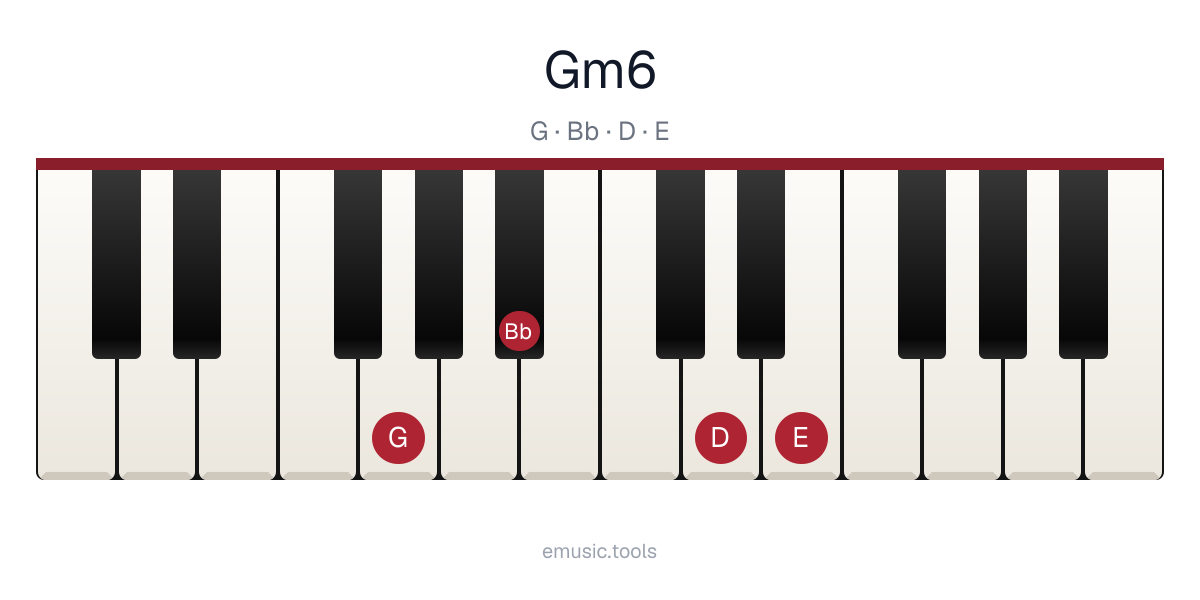
Switch to the interactive diagram to hear the chord, change voicing and swap finger numbers for note names.
To play Gm6 on piano, place your right hand with your thumb on G, index finger on B♭, middle finger on D and little finger on E. Press the keys together and listen for an even sound. On the keyboard B♭ is a black key and G, D and E are white. Practice moving in and out of the chord slowly, then bring in a metronome.
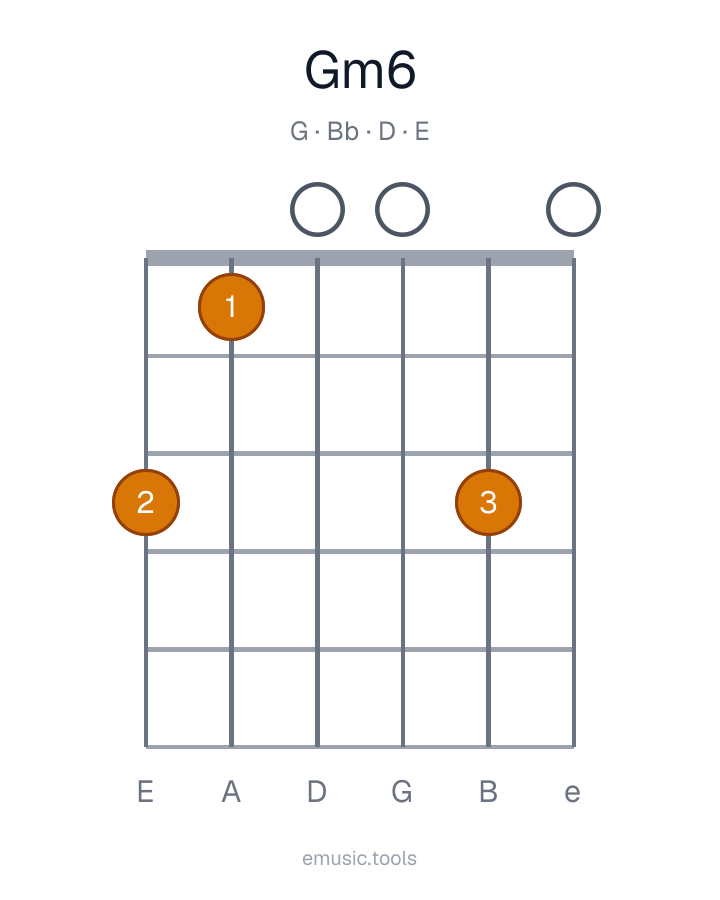
Switch to the interactive diagram to hear the chord, change voicing and swap finger numbers for note names.
On guitar, Gm6 is commonly played with the voicing shown above. The fretted notes sit between frets 1 and 3. Strings 4, 3 and 1 ring open.
G · B♭ · D · E
Try Gm6 on the virtual piano
Free, in your browser: play with the mouse, your computer keyboard or a USB MIDI keyboard. No sign-up.
| Degree | Interval | Semitones | Note | Hear |
|---|---|---|---|---|
| 1 | Root | 0 | G | |
| ♭3 | Minor third | 3 | B♭(Bb) | |
| 5 | Perfect fifth | 7 | D | |
| 6 | Major sixth | 9 | E |
The Gm6 chord is built from a root, a minor third, a perfect fifth and a major sixth. Start at the root G and stack the intervals to get the whole chord: G, B♭, D and E. The same formula gives you the chord in any other key.
Minor sixth chords act as the iv chord in a major key or as the tonic of a Dorian passage, and they are a staple of jazz turnarounds. They also make a striking substitute for a plain minor chord at a cadence.
Gm6 adds a major sixth to Gm, where Gm7 adds a minor seventh a half step higher. That major sixth forms a tritone with the minor third, which gives the chord its bittersweet tension. The same four notes spell the half-diminished chord built on its sixth.
A minor chord works as the tonic of its own key, and as the vi or the ii of a major one. Each progression below is written in the key its numerals name.
We use cookies to measure how the site is used and remember your settings. Details in our Privacy Policy.