


F♭7♯5 Chord: Guitar, Piano and Notes
The F♭7♯5 chord is a altered dominant seventh chord built on the root note F♭. Its notes are F♭, A♭, C and E𝄫. It's enharmonically the same chord as E7♯5.
Dominant seventh sharp five chords sound restless and a little exotic. Raising the fifth of a dominant seventh trades its usual bluesy pull for a sharper, whole-tone edge, a colour jazz and gospel players reach for right before a cadence.
- Notes
- F♭ · A♭ · C · E𝄫
- Formula
- 1 · 3 · ♯5 · ♭7
- Semitones
- 0 · 4 · 8 · 10
- Note
- F♭
- Quality
- Dominant 7♯5
- Symbol
- F♭7♯5
F♭7♯5 on piano
4 notes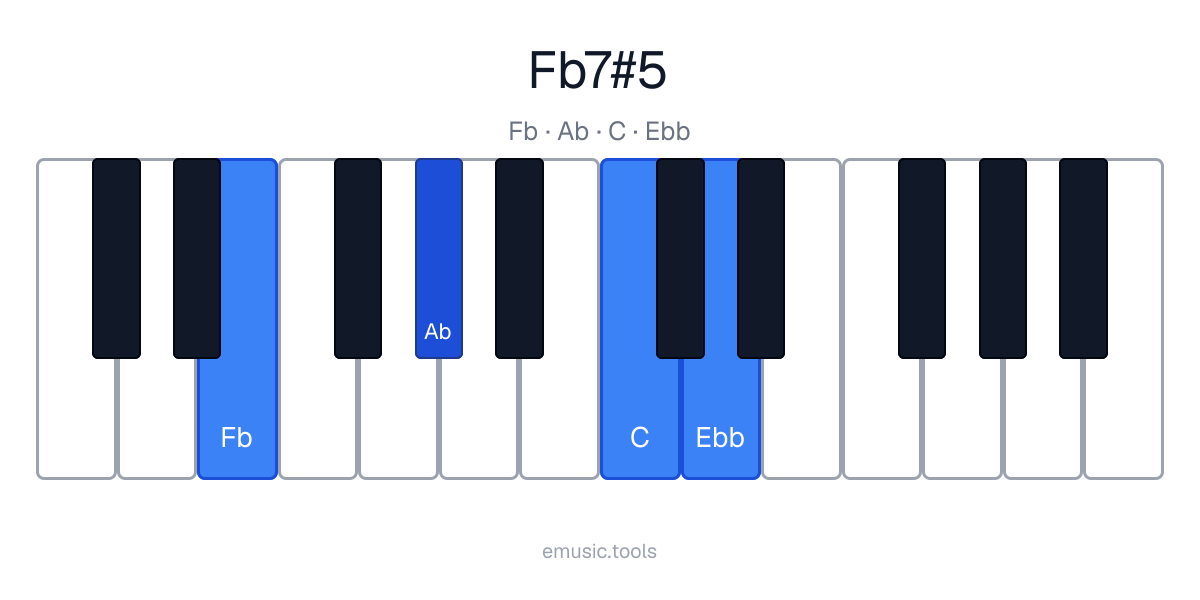
Switch to the interactive diagram to hear the chord, change voicing and swap finger numbers for note names.
To play F♭7♯5 on piano, place your right hand with your thumb on F♭, index finger on A♭, middle finger on C and little finger on E𝄫. Press the keys together and listen for an even sound. Practice moving in and out of the chord slowly, then bring in a metronome.
- F♭1
- A♭3
- C♯5
- E𝄫♭7
F♭7♯5 on guitar
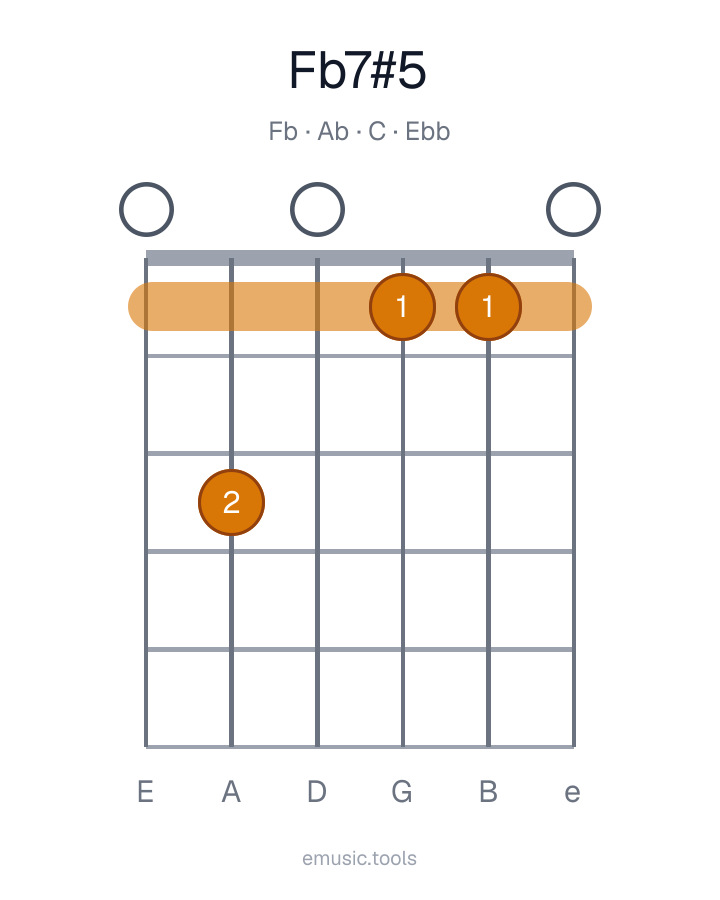
Switch to the interactive diagram to hear the chord, change voicing and swap finger numbers for note names.
On guitar, F♭7♯5 is commonly played with the voicing shown above. This one is a barre shape: keep the index finger flat across the fretboard and curve the others so they don't mute the strings next to them. Strum only the strings marked as active in the diagram.
F♭7♯5 chord notes
Also known as E7♯5
| Degree | Interval | Semitones | Note | Hear |
|---|---|---|---|---|
| 1 | Root | 0 | F♭(Fb) | |
| 3 | Major third | 4 | A♭(Ab) | |
| ♯5 | Augmented fifth | 8 | C | |
| ♭7 | Minor seventh | 10 | E𝄫(Ebb) |
How to use the F♭7♯5 chord
The F♭7♯5 chord is built from a root, a major third, an augmented fifth and a minor seventh. Start at the root F♭ and stack the intervals to get the whole chord: F♭, A♭, C and E𝄫. The same formula gives you the chord in any other key.
Dominant seventh sharp five chords turn up in jazz and gospel as an altered V7 resolving to the tonic, especially where the melody climbs through the raised fifth. They are a common sound in turnarounds right before landing back on I.
Where F♭7♯5 is used
No progression is shown for this spelling
Every key F♭7♯5 would have a function in has a tonic that needs a double accidental, which is not a key this library teaches. The enharmonic spelling carries the same chord in a key that exists.
Questions people ask
- What notes are in the F♭7♯5 chord?
- The F♭7♯5 chord contains F♭, A♭, C and E𝄫 (Fb, Ab, C and Ebb in plain text).
- Is the F♭7♯5 chord major or minor?
- F♭7♯5 is a altered dominant seventh chord. Dominant seventh sharp five chords sound restless and a little exotic. Raising the fifth of a dominant seventh trades its usual bluesy pull for a sharper, whole-tone edge, a colour jazz and gospel players reach for right before a cadence.
- How do you play F♭7♯5 on piano?
- Place your fingers on F♭, A♭, C and E𝄫 and play them together. The root usually goes to the little finger of the left hand, the upper notes to the right.
- How do you play F♭7♯5 on guitar?
- F♭7♯5 is typically played with the fingering shown in the diagram above. If one of the chord tones lines up with an open string, an open position is worth trying too.
- What is another name for the F♭7♯5 chord?
- F♭7♯5 is enharmonically equivalent to E7♯5. Both chord names describe exactly the same notes, but the spelling depends on the key you are playing in.