


E♯5 Chord: Guitar, Piano and Notes
The E♯5 chord is a power chord built on the root note E♯. Its notes are E♯ and B♯. It's enharmonically the same chord as F5.
Power chords have no third at all, only a root and a fifth, so they are neither major nor minor. That emptiness is the point: run one through a distorted amp and it stays clean and thick where a full triad would turn to mud.
- Notes
- E♯ · B♯
- Formula
- 1 · 5
- Semitones
- 0 · 7
- Note
- E♯
- Quality
- Power Chord (5)
- Symbol
- E♯5
E♯5 on piano
2 notes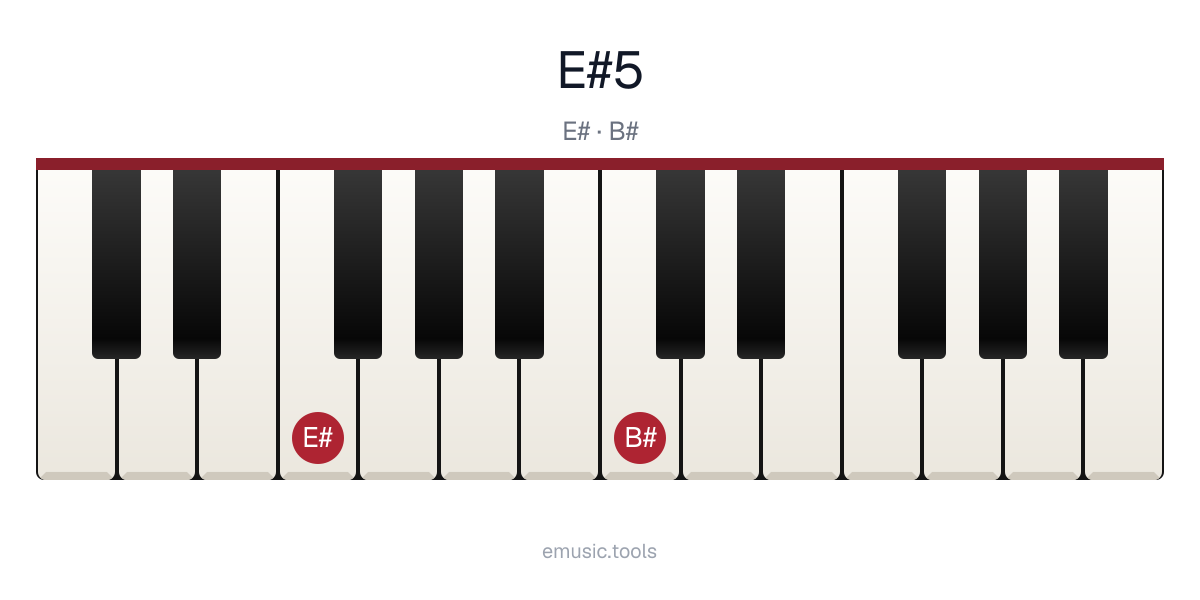
Switch to the interactive diagram to hear the chord, change voicing and swap finger numbers for note names.
To play E♯5 on piano, place your right hand with your thumb on E♯ and little finger on B♯. Press the keys together and listen for an even sound. On the keyboard every note of E♯5 is a white key, the keys you'd normally call F and C. Practice moving in and out of the chord slowly, then bring in a metronome.
- E♯1
- B♯5
E♯5 on guitar
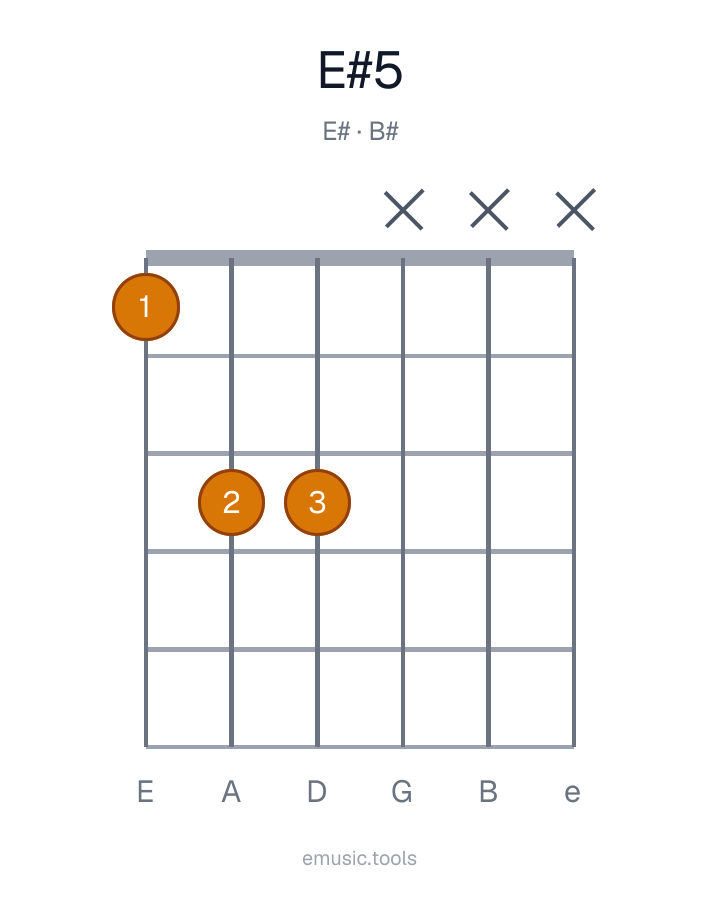
Switch to the interactive diagram to hear the chord, change voicing and swap finger numbers for note names.
On guitar, E♯5 is commonly played with the voicing shown above. The fretted notes sit between frets 1 and 3. Don't play strings 3, 2 and 1.
E♯ · B♯
Play E♯5 on the online piano
Free, in your browser: play with the mouse, your computer keyboard or a USB MIDI keyboard. No sign-up.
E♯5 chord notes
Also known as F5
| Degree | Interval | Semitones | Note | Hear |
|---|---|---|---|---|
| 1 | Root | 0 | E♯(E#) | |
| 5 | Perfect fifth | 7 | B♯(B#) |
How to use the E♯5 chord
The E♯5 chord is built from a root and a perfect fifth. Start at the root E♯ and stack the intervals to get the whole chord: E♯ and B♯. The same formula gives you the chord in any other key.
Power chords drive punk, metal, grunge and hard rock, played on the low strings with distortion. Guitarists move a single shape up and down the neck, which is why riffs built from them transpose so easily.
How E♯5 differs from similar chords
E♯5 holds only the root and the fifth, so unlike E♯ or E♯m it has no third to decide its colour. With two notes it is the smallest chord in the library, often doubled with the root an octave up. The same E♯5 shape therefore fits major and minor songs alike.
Where E♯5 is used
No progression is shown for a power chord
E♯5 has no third, so it carries no major or minor function and cannot take a Roman numeral. Any progression printed here would belong to a different chord.
Questions people ask
- What notes are in the E♯5 chord?
- The E♯5 chord contains E♯ and B♯ (E# and B# in plain text).
- Is the E♯5 chord major or minor?
- E♯5 is a power chord. Power chords have no third at all, only a root and a fifth, so they are neither major nor minor. That emptiness is the point: run one through a distorted amp and it stays clean and thick where a full triad would turn to mud.
- How do you play E♯5 on piano?
- Place your fingers on E♯ and B♯ and play them together. The root usually goes to the little finger of the left hand, the upper notes to the right. On the keyboard every note of E♯5 is a white key, the keys you'd normally call F and C.
- How do you play E♯5 on guitar?
- Use the fingering in the diagram above. The fretted notes sit between frets 1 and 3. Don't play strings 3, 2 and 1.
- What is another name for the E♯5 chord?
- E♯5 is enharmonically equivalent to F5. Both chord names describe exactly the same notes, but the spelling depends on the key you are playing in.