


C5 Chord: Guitar, Piano and Notes
The C5 chord is a power chord built on the root note C. Its notes are C and G.
Power chords have no third at all, only a root and a fifth, so they are neither major nor minor. That emptiness is the point: run one through a distorted amp and it stays clean and thick where a full triad would turn to mud.
- Notes
- C · G
- Formula
- 1 · 5
- Semitones
- 0 · 7
- Note
- C
- Quality
- Power Chord (5)
- Symbol
- C5
C5 on piano
2 notes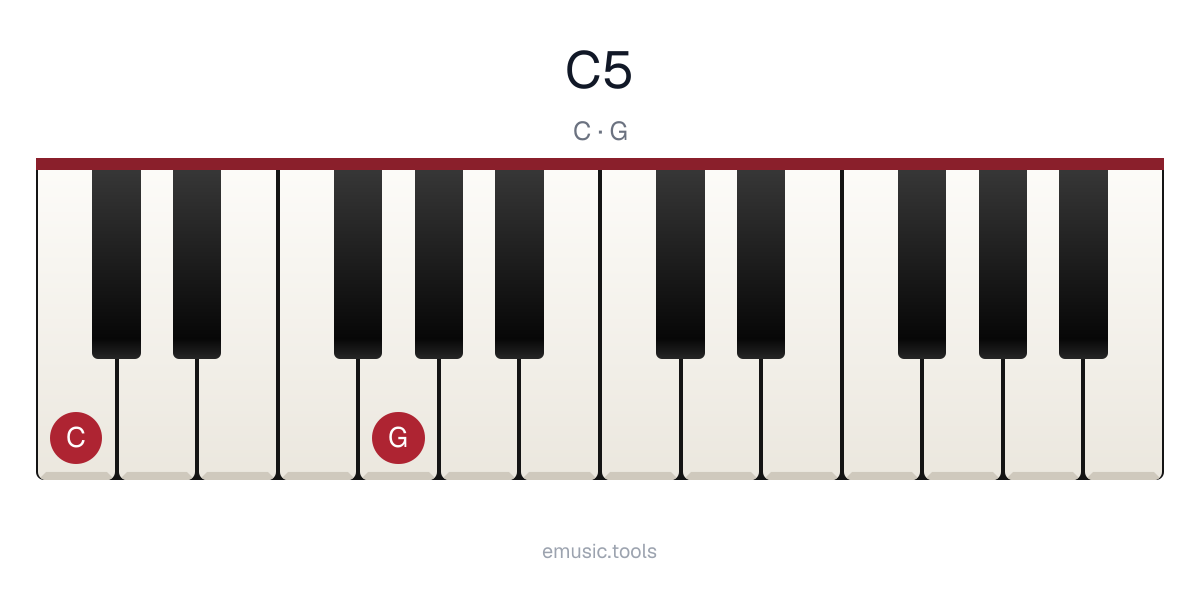
Switch to the interactive diagram to hear the chord, change voicing and swap finger numbers for note names.
To play C5 on piano, place your right hand with your thumb on C and little finger on G. Press the keys together and listen for an even sound. On the keyboard every note of C5 is a white key. Practice moving in and out of the chord slowly, then bring in a metronome.
- C1
- G5
C5 on guitar
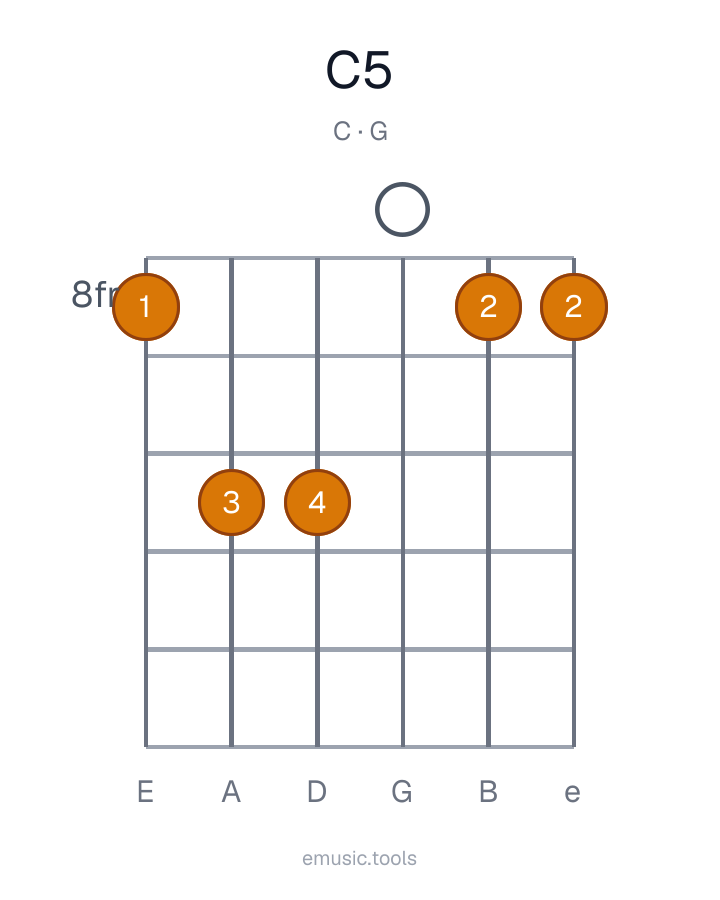
Switch to the interactive diagram to hear the chord, change voicing and swap finger numbers for note names.
On guitar, C5 is commonly played with the voicing shown above. The fretted notes sit between frets 8 and 10. String 3 rings open.
C · G
Try C5 on the virtual piano
Free, in your browser: play with the mouse, your computer keyboard or a USB MIDI keyboard. No sign-up.
C5 chord notes
| Degree | Interval | Semitones | Note | Hear |
|---|---|---|---|---|
| 1 | Root | 0 | C | |
| 5 | Perfect fifth | 7 | G |
How to use the C5 chord
The C5 chord is built from a root and a perfect fifth. Start at the root C and stack the intervals to get the whole chord: C and G. The same formula gives you the chord in any other key.
Power chords drive punk, metal, grunge and hard rock, played on the low strings with distortion. Guitarists move a single shape up and down the neck, which is why riffs built from them transpose so easily.
How C5 differs from similar chords
C5 holds only the root and the fifth, so unlike C or Cm it has no third to decide its colour. With two notes it is the smallest chord in the library, often doubled with the root an octave up. The same C5 shape therefore fits major and minor songs alike.
Where C5 is used
Questions people ask
- What notes are in the C5 chord?
- The C5 chord contains C and G.
- Is the C5 chord major or minor?
- C5 is a power chord. Power chords have no third at all, only a root and a fifth, so they are neither major nor minor. That emptiness is the point: run one through a distorted amp and it stays clean and thick where a full triad would turn to mud.
- How do you play C5 on piano?
- Place your fingers on C and G and play them together. The root usually goes to the little finger of the left hand, the upper notes to the right. On the keyboard every note of C5 is a white key.
- How do you play C5 on guitar?
- Use the fingering in the diagram above. The fretted notes sit between frets 8 and 10. String 3 rings open.
- What chords work well with C5?
- C5 pairs naturally with the chords in the related section: a perfect fifth up or down, the relative major or minor, and anything sharing two notes with it.