


As the VE♭ major
- ii7Fm7
- V7♭9B♭7♭9
- Imaj7E♭maj7
B♭7♭9 is the chord that wants to resolve, so ending the loop on it hands straight back to the top.
The B♭7♭9 chord is a altered dominant seventh chord built on the root note B♭. Its notes are B♭, D, F, A♭ and C♭. It's enharmonically the same chord as A♯7♭9.
Dominant seventh flat nine chords sound dark and urgent. Stacking a minor ninth on a dominant seventh tightens the tension already built into the tritone, which makes the chord a strong pull toward a minor tonic.
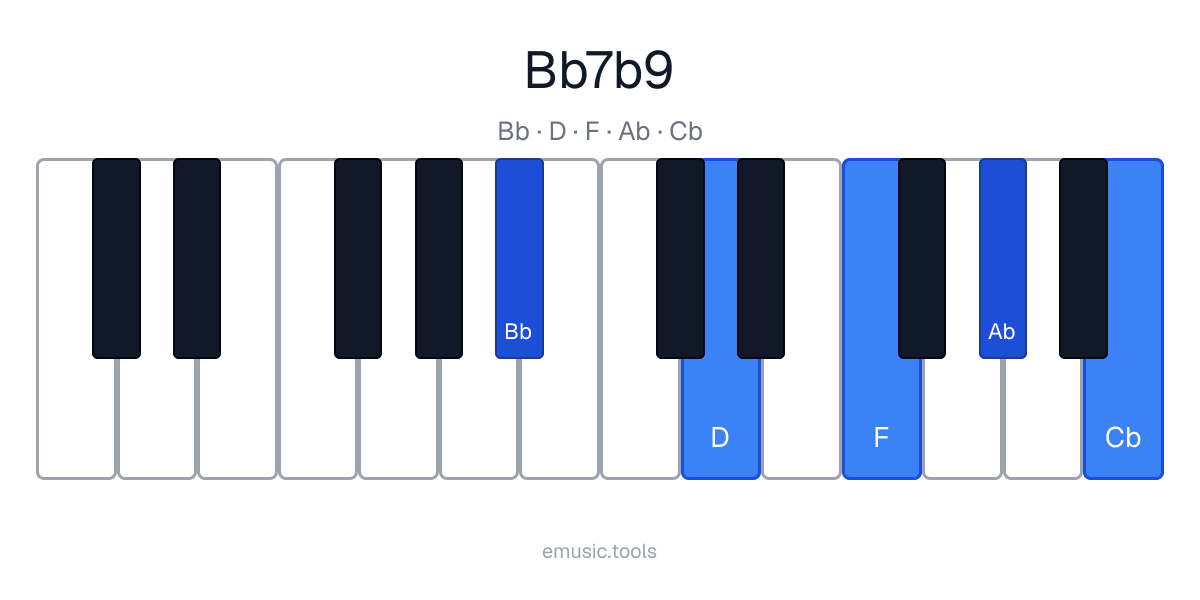
Switch to the interactive diagram to hear the chord, change voicing and swap finger numbers for note names.
To play B♭7♭9 on piano, place your right hand with your thumb on B♭, index finger on D, middle finger on F, ring finger on A♭ and little finger on C♭. Press the keys together and listen for an even sound. On the keyboard B♭ and A♭ are black keys and D, F and C♭ are white. C♭ is the key you'd normally call B. The thumb starts on a black key, so slide the whole hand a little further in, towards the fallboard. Practice moving in and out of the chord slowly, then bring in a metronome.
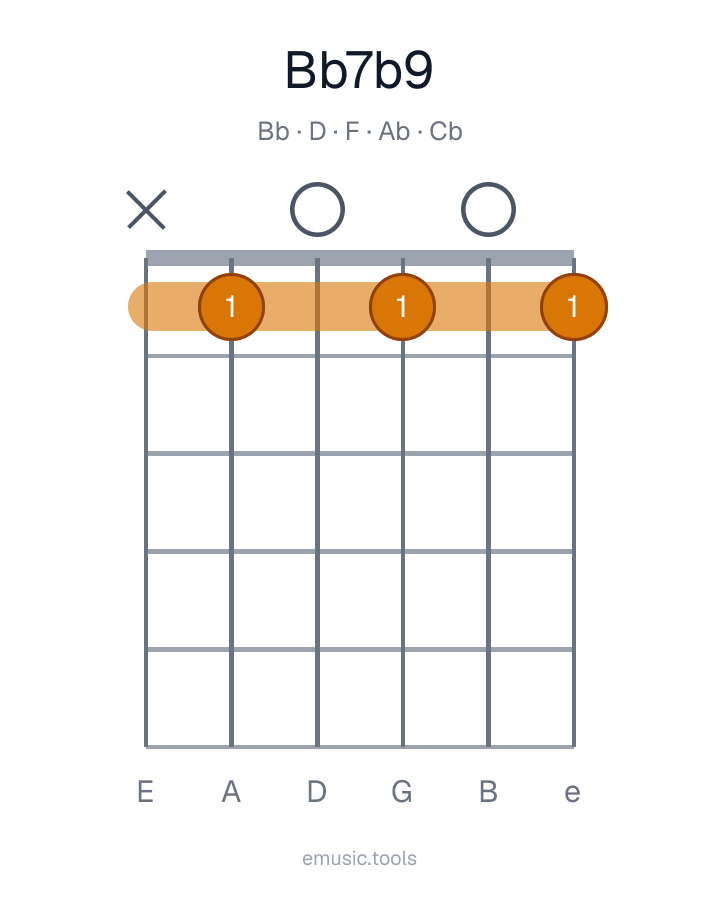
Switch to the interactive diagram to hear the chord, change voicing and swap finger numbers for note names.
On guitar, B♭7♭9 is commonly played with the voicing shown above. Strings 4 and 2 ring open. Don't play string 6.
B♭ · D · F · A♭ · C♭
Try B♭7♭9 on the virtual piano
Free, in your browser: play with the mouse, your computer keyboard or a USB MIDI keyboard. No sign-up.
Also known as A♯7♭9
| Degree | Interval | Semitones | Note | Hear |
|---|---|---|---|---|
| 1 | Root | 0 | B♭(Bb) | |
| 3 | Major third | 4 | D | |
| 5 | Perfect fifth | 7 | F | |
| ♭7 | Minor seventh | 10 | A♭(Ab) | |
| ♭9 | Minor ninth | 13 | C♭(Cb) |
The B♭7♭9 chord is built from a root, a major third, a perfect fifth, a minor seventh and a minor ninth. Start at the root B♭ and stack the intervals to get the whole chord: B♭, D, F, A♭ and C♭. The same formula gives you the chord in any other key.
Dominant seventh flat nine chords are the classic altered dominant of bebop and gospel, most often the V7 of a ii-V-i in a minor key. Gospel piano voices this chord thick under the vocal line right before it resolves.
B♭7♭9 is B♭7 with a minor ninth, a half step above the root, where B♭9 has a major ninth. Leave out the root and the other four notes form a diminished seventh chord a major third up. That is why it pulls so hard towards a minor chord a fifth below.
A dominant chord wants to resolve. Its home is the V of a major key - and the I of a blues, where the pull never lets up.
B♭7♭9 is the chord that wants to resolve, so ending the loop on it hands straight back to the top.
We use cookies to measure how the site is used and remember your settings. Details in our Privacy Policy.