


B♭ Kumoi at a glance
Kumoi is a beloved Japanese pentatonic that anime, game and film composers reach for when they want a Japanese flavour without the obvious cliché of Hirajōshi. Sounds calm and slightly ambiguous. Built on the root B♭, the scale takes on the specific colour and pitch range of that key - making it especially useful in genres and registers where B♭ is a comfortable tonal centre.
| Notes | B♭ C D♭ F G |
|---|---|
| Formula | 1P · 2M · 3m · 5P · 6M |
| Step pattern | W H 2W W W+H |
B♭ Kumoi on the piano
Improvisation drone · B♭
Loop the root note as a pad to practice improvising over this scale.
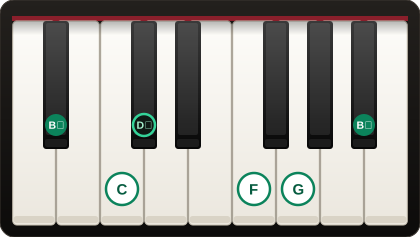
On the piano B♭ Kumoi uses two black keys (B♭ and D♭) and three white.
B♭ · C · D♭ · F · G
Play B♭ Kumoi on the online piano
Free, in your browser: play with the mouse, your computer keyboard or a USB MIDI keyboard. No sign-up.
B♭ Kumoi on the guitar
B♭ Kumoi - fr 0–12
B♭ Kumoi on the staff
Notes of the B♭ Kumoi scale
| Degree | Note | Interval | Semitones | Hear |
|---|---|---|---|---|
| 1 | B♭ | unison1P | 0 | |
| 2 | C | major 2nd2M | 2 | |
| 3 | D♭ | minor 3rd3m | 3 | |
| 4 | F | perfect 5th5P | 7 | |
| 5 | G | major 6th6M | 9 |
What makes B♭ Kumoi different
Kumoi (1, 2, ♭3, 5, 6) has a minor third but a major sixth, and no fourth or seventh. That pairing is the Dorian colour, and every note of Kumoi belongs to Dorian on the same root. Its only half step, between 2 and ♭3, sits low in the scale, and above it the scale moves in a major third, a whole step and a minor third. Hirajōshi has the same shape except for the sixth: ♭6 there, 6 here. On B♭, B♭ Kumoi is B♭ Dorian (B♭ C D♭ E♭ F G A♭) without E♭ and A♭.
How to use the B♭ Kumoi scale
Because B♭ Kumoi has fewer or more than seven notes, it doesn't produce a standard set of seven diatonic triads. Instead, build chords by stacking thirds within the scale or use it as a melodic colour over chords drawn from a related diatonic key.
Kumoi is a beloved Japanese pentatonic that anime, game and film composers reach for when they want a Japanese flavour without the obvious cliché of Hirajōshi. Sounds calm and slightly ambiguous.
Practice tips
Practise Kumoi as four-note phrases that lean on the major sixth — it's the colour that distinguishes Kumoi from a plain minor pentatonic.
Formula & step pattern
The B♭ Kumoi scale follows Japanese pentatonic with intervals 1, 2, ♭3, 5, 6 — minor third softened by major second and major sixth. Step pattern: W - H - 2W - W - W+H. Intervals from the root: 1P · 2M · 3m · 5P · 6M. Memorising the formula lets you transpose the scale to any other root note quickly.
Where you will hear B♭ Kumoi
Start with the music described above: listen for B♭ Kumoi in it and transcribe a few short phrases by ear. It's the quickest way to learn how the scale sounds.
Questions people ask
What notes are in the B♭ Kumoi scale?
The B♭ Kumoi scale contains B♭, C, D♭, F and G.
What is the formula for the B♭ Kumoi scale?
B♭ Kumoi follows Japanese pentatonic with intervals 1, 2, ♭3, 5, 6 — minor third softened by major second and major sixth.
Is B♭ Kumoi a major or minor scale?
B♭ Kumoi is a kumoi scale. Japanese pentatonic scale (1, 2, ♭3, 5, 6) — minor third with a major second and major sixth, drifting and meditative.
What chords belong to the B♭ Kumoi scale?
B♭ Kumoi doesn't produce a standard seven-chord diatonic set. Use chords from a related diatonic scale instead.
Which genres use B♭ Kumoi?
Kumoi is a beloved Japanese pentatonic that anime, game and film composers reach for when they want a Japanese flavour without the obvious cliché of Hirajōshi. Sounds calm and slightly ambiguous.
How do you play the B♭ Kumoi scale on the piano?
On the piano B♭ Kumoi uses two black keys (B♭ and D♭) and three white.
What is the difference between B♭ Kumoi and B♭ Dorian?
On B♭, B♭ Kumoi is B♭ Dorian (B♭ C D♭ E♭ F G A♭) without E♭ and A♭.
How do I practise the B♭ Kumoi scale?
Practise Kumoi as four-note phrases that lean on the major sixth — it's the colour that distinguishes Kumoi from a plain minor pentatonic.