


As the tonic (I)B♯ major
Home. The loop leaves B♯6/9 and keeps coming back to it.
The B♯6/9 chord is a six-nine chord built on the root note B♯. Its notes are B♯, D𝄪, F𝄪, G𝄪 and C𝄪. It's enharmonically the same chord as C6/9.
Six-nine chords sound bright and pleasantly unresolved. A major sixth and a ninth sit on the triad with no seventh at all, so the chord never pulls toward a resolution and can simply sit there, which is why bands often end a song on one.
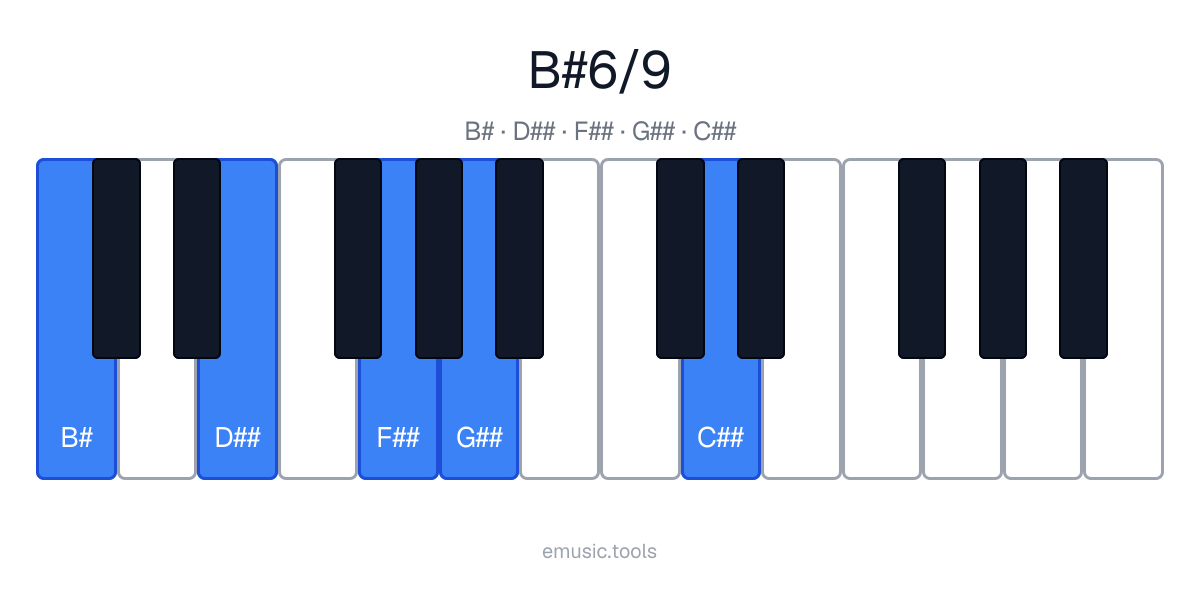
Switch to the interactive diagram to hear the chord, change voicing and swap finger numbers for note names.
To play B♯6/9 on piano, place your right hand with your thumb on B♯, index finger on D𝄪, middle finger on F𝄪, ring finger on G𝄪 and little finger on C𝄪. Press the keys together and listen for an even sound. Practice moving in and out of the chord slowly, then bring in a metronome.
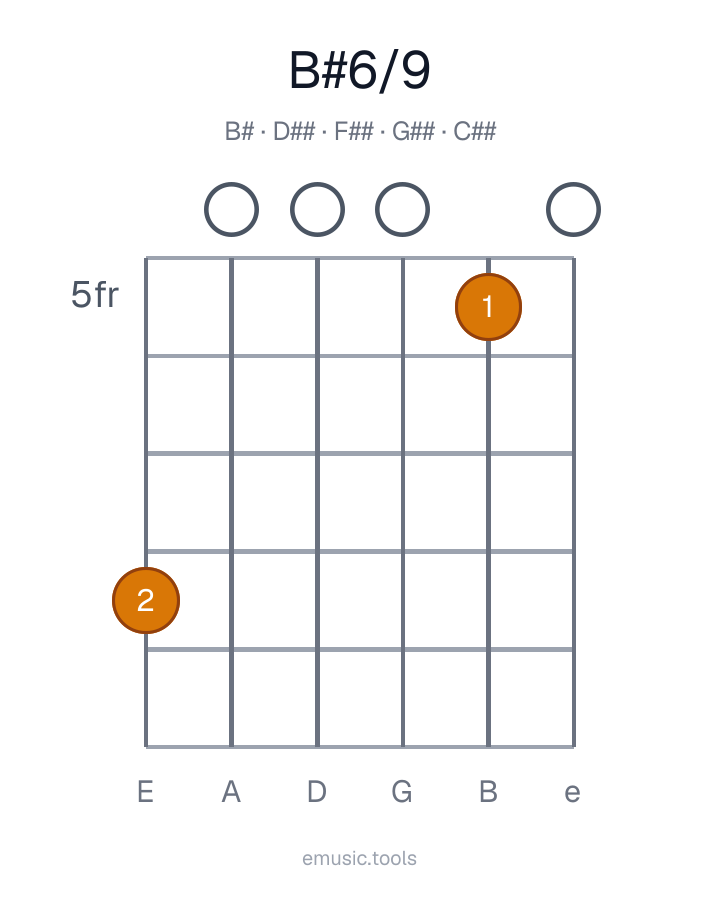
Switch to the interactive diagram to hear the chord, change voicing and swap finger numbers for note names.
On guitar, B♯6/9 is commonly played with the voicing shown above. Strum only the strings marked as active in the diagram.
Also known as C6/9
| Degree | Interval | Semitones | Note | Hear |
|---|---|---|---|---|
| 1 | Root | 0 | B♯(B#) | |
| 3 | Major third | 4 | D𝄪(D##) | |
| 5 | Perfect fifth | 7 | F𝄪(F##) | |
| 6 | Major sixth | 9 | G𝄪(G##) | |
| 9 | Major ninth | 14 | C𝄪(C##) |
The B♯6/9 chord is built from a root, a major third, a perfect fifth, a major sixth and a major ninth. Start at the root B♯ and stack the intervals to get the whole chord: B♯, D𝄪, F𝄪, G𝄪 and C𝄪. The same formula gives you the chord in any other key.
Six-nine chords are a favourite ending for jazz standards and pop ballads, taking the place of a plain major or major seventh chord as the final I. They also work as a colourful substitute for a major triad anywhere in a progression.
A major chord is at home as a tonic, and just as useful as the IV or the V of a neighbouring key. Each progression below is written in the key its numerals name.
We use cookies to measure how the site is used and remember your settings. Privacy Policy.