


C Locrian at a glance
Locrian is rare as a tonal centre because of that diminished tonic, but you need to know it for modal theory. Shows up in metal and avant-garde jazz. Built on the root C, the scale takes on the specific colour and pitch range of that key - making it especially useful in genres and registers where C is a comfortable tonal centre.
| Notes | C D♭ E♭ F G♭ A♭ B♭ |
|---|---|
| Formula | 1P · 2m · 3m · 4P · 5d · 6m · 7m |
| Step pattern | H W W H W W W |
| Chords in the key | C°D♭E♭mFmG♭A♭B♭m |
Chords in the C Locrian scale
These are the chords that naturally form on each degree of the scale. Click a chord to open its dedicated page.
C Locrian on the piano
Improvisation drone · C
Loop the root note as a pad to practice improvising over this scale.
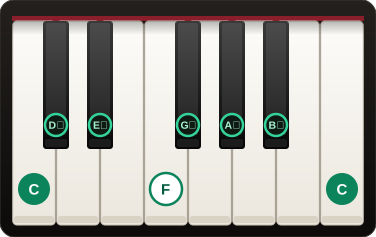
On the piano C Locrian uses five black keys (D♭, E♭, G♭, A♭ and B♭) and two white.
C · D♭ · E♭ · F · G♭ · A♭ · B♭
Play C Locrian on the online piano
Free, in your browser: play with the mouse, your computer keyboard or a USB MIDI keyboard. No sign-up.
C Locrian on the guitar
C Locrian - fr 0–12
C Locrian on the staff
Notes of the C Locrian scale
| Degree | Note | Interval | Semitones | Hear |
|---|---|---|---|---|
| 1 | C | unison1P | 0 | |
| 2 | D♭ | minor 2nd2m | 1 | |
| 3 | E♭ | minor 3rd3m | 3 | |
| 4 | F | perfect 4th4P | 5 | |
| 5 | G♭ | diminished 5th5d | 6 | |
| 6 | A♭ | minor 6th6m | 8 | |
| 7 | B♭ | minor 7th7m | 10 |
What makes C Locrian different
Locrian is the only mode of the major scale with a diminished fifth, so its tonic chord is a diminished triad rather than a major or minor one. That flat fifth is the one note separating it from Phrygian. Without a perfect fifth the tonic never sounds at rest, which is why whole pieces in Locrian are rare and the mode lives mostly in theory, over half-diminished chords in jazz, and in metal riffs. It's the seventh mode of the major scale, so it shares its notes with the major scale a half step above its root. On C, C Locrian has G♭ where C Phrygian has G; every other note is shared with C Phrygian (C D♭ E♭ F G A♭ B♭).
Modes from C Locrian
Each note of this scale produces a different mode with its own character.
How to use the C Locrian scale
The diatonic chords of C Locrian are: i° = C°, II = D♭, iii = E♭m, iv = Fm, V = G♭, VI = A♭, vii = B♭m. These seven chords belong naturally to the key and are the safest harmonic vocabulary when writing songs in C Locrian. Each one in the chord table on this page opens its own diagram and progressions.
Locrian is rare as a tonal centre because of that diminished tonic, but you need to know it for modal theory. Shows up in metal and avant-garde jazz.
Practice tips
Locrian works best as a theoretical exercise. Spell each diatonic chord and notice why that diminished tonic makes it so unstable.
Formula & step pattern
The C Locrian scale follows a minor scale with a flat second and a flat fifth (H-W-W-H-W-W-W). Step pattern: H - W - W - H - W - W - W. Intervals from the root: 1P · 2m · 3m · 4P · 5d · 6m · 7m. Memorising the formula lets you transpose the scale to any other root note quickly.
Where you will hear C Locrian
Start with the music described above: listen for C Locrian in it and transcribe a few short phrases by ear. It's the quickest way to learn how the scale sounds.
Questions people ask
What notes are in the C Locrian scale?
The C Locrian scale contains C, D♭, E♭, F, G♭, A♭ and B♭.
What is the formula for the C Locrian scale?
C Locrian follows a minor scale with a flat second and a flat fifth (H-W-W-H-W-W-W).
Is C Locrian a major or minor scale?
C Locrian is a locrian scale. The unstable seventh mode - diminished tonic and a flat fifth, rarely used as tonal centre.
What chords belong to the C Locrian scale?
The diatonic chords of C Locrian are C°, D♭, E♭m, Fm, G♭, A♭, B♭m.
Which genres use C Locrian?
Locrian is rare as a tonal centre because of that diminished tonic, but you need to know it for modal theory. Shows up in metal and avant-garde jazz.
How do you play the C Locrian scale on the piano?
On the piano C Locrian uses five black keys (D♭, E♭, G♭, A♭ and B♭) and two white.
What is the difference between C Locrian and C Phrygian?
On C, C Locrian has G♭ where C Phrygian has G; every other note is shared with C Phrygian (C D♭ E♭ F G A♭ B♭).
How do I practise the C Locrian scale?
Locrian works best as a theoretical exercise. Spell each diatonic chord and notice why that diminished tonic makes it so unstable.