


The circle of fifths is one of those things every musician comes across at some point, but not everyone really understands it. That's a shame, because once it clicks, a lot of things start to make sense. Here is a clear and practical way to look at it and actually use it.
What is the circle of fifths?
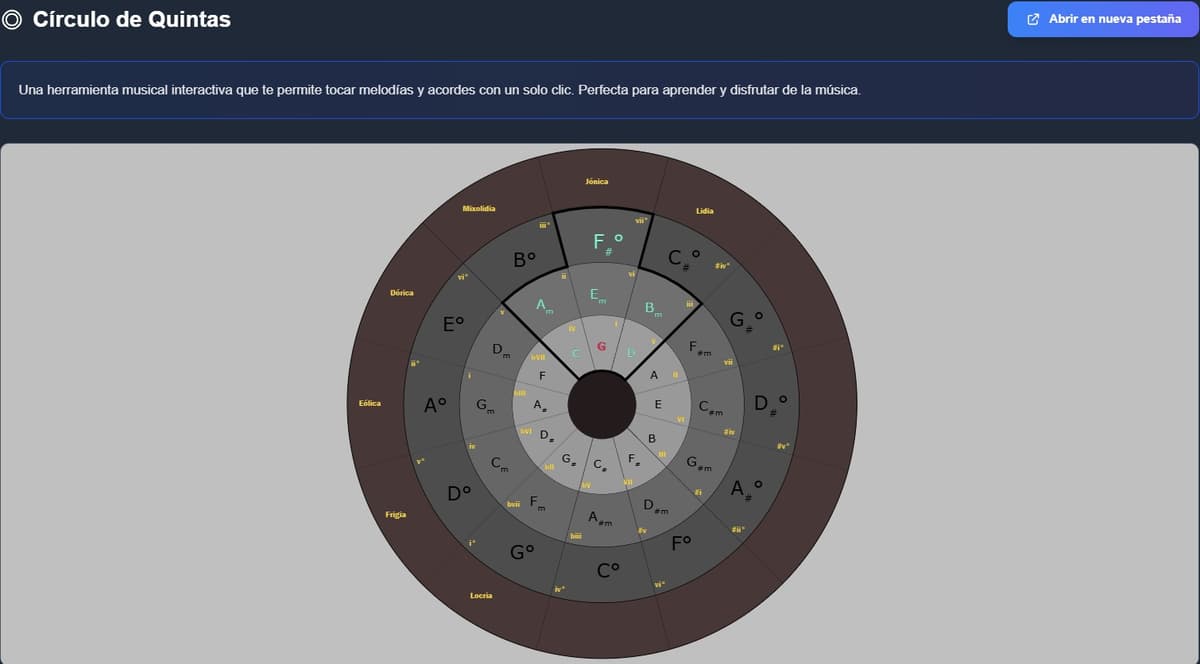
It's a circular diagram that organizes the 12 musical keys based on the distance between them. Each key is a perfect fifth apart from the next one. If you start on C and go up a fifth, you get G. From G, another fifth takes you to D, then A, and so on until the circle closes and brings you back to C.
It's not just theory. It's a map of how keys connect to each other.
What is it actually useful for?
More than memorizing it, what matters is what you can do with it:
- See which keys are related
- Know the notes in each scale
- Find chords that work well together
- Build natural sounding progressions
- Change key without it sounding awkward
- Identify major keys and their relative minors
Used properly, it saves a lot of trial and error.
How to read it without getting lost
Major keys
The outer part of the circle shows the major keys. If you move clockwise, each step adds a sharp. If you move counterclockwise, you add a flat. C major sits at the top and has no sharps or flats.
Relative minor keys
Inside the circle you find the relative minors. Each major key has a relative minor that uses exactly the same notes. For example, C major and A minor. The difference is the tonal center, not the notes themselves. This explains why two songs can use the same notes but feel completely different.
The most useful trick: neighbors work
This is where the circle becomes really practical. Keys that sit next to each other share many notes. That's why their chords tend to sound good together. This is behind very common progressions like:
- I - V - vi - IV
- I - IV - V
- ii - V - I
It's not random. They're all close within the circle.
Quick examples in C
- I - V - vi - IV: C - G - Am - F
- ii - V - I: Dm - G - C
- I - IV - V: C - F - G
All these chords are directly related in the circle.
How to start using it
You don't need to memorize everything at once. Start like this:
- Pick a key, for example C
- Look at its main chords
- Check its neighboring keys
- Build progressions using those chords
- Try small changes without going too far
With time, you start recognizing patterns naturally.
Conclusion
The circle of fifths is not complicated theory. It's a visual way to understand why certain chords and keys work well together. Once you internalize it, you stop guessing and start making intentional choices when playing or writing music.


